May 13, 2026
How Much Caffeine in Espresso vs Drip vs Cold Brew
The most-asked caffeine question in coffee has a straightforward answer once the unit is fixed. Per ounce, espresso has the most caffeine. Per typical serving, cold brew has the most. Drip coffee sits in the middle on both axes. The rest of the conversation is variations on the bean, the brew time, and what counts as a serving. This post breaks down the numbers from USDA and Specialty Coffee Association reference data, walks through the chemistry that explains the differences, and gets practical about which method to choose when caffeine is the variable that matters.
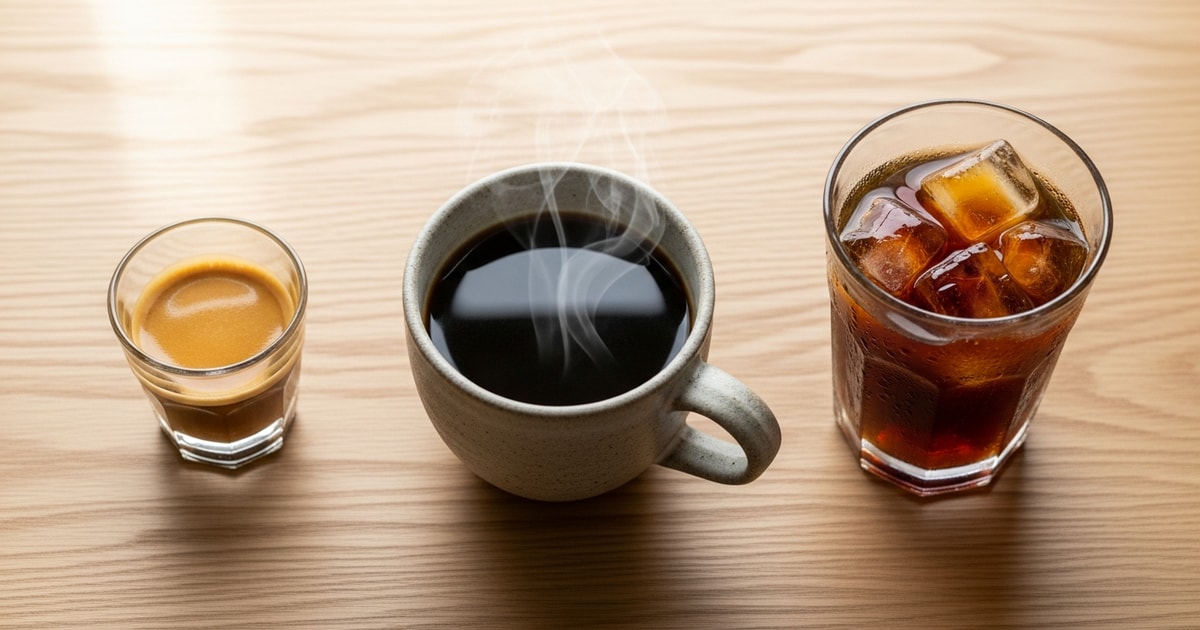
The short version, for the skimmers. A 1.5oz double shot of espresso carries 63 to 80 milligrams of caffeine. An 8oz cup of drip coffee carries 95 to 165 milligrams. A 16oz cold brew, diluted from concentrate, carries 200 to 320 milligrams. Each method extracts caffeine differently, the bean variety matters, and the volume of liquid consumed almost always swamps the concentration difference between methods.
How caffeine actually works
Caffeine is a stimulant alkaloid found naturally in coffee, tea, cacao, and a handful of other plants. The compound binds to adenosine receptors in the brain and prevents adenosine, the molecule that produces the felt sense of being tired, from binding. The blocked receptors free the central nervous system to keep firing. The result is alertness, sometimes elevated heart rate, sometimes anxiety in higher doses, and a measurable boost in physical and cognitive performance.
The half-life of caffeine in adult humans averages 5 to 6 hours, with significant variation. Pregnancy extends it. Smoking shortens it. Certain medications (including hormonal birth control and antifungals like fluconazole) can double or triple the half-life by inhibiting the liver enzyme CYP1A2 that metabolizes the compound. The peak plasma concentration after oral consumption lands 30 to 60 minutes after drinking. A 300 milligram morning dose is still measurable in the bloodstream past midnight.
The U.S. Food and Drug Administration recommends a daily ceiling of 400 milligrams for healthy adults. The European Food Safety Authority sets the same ceiling. That works out to roughly four 8oz cups of drip coffee, or two 16oz cold brews, or five double espressos. Above 400 milligrams, the side effects (jitters, elevated heart rate, sleep disruption, gastrointestinal upset) start outpacing the benefits for most drinkers.
The three methods in numbers
The numbers below are SCA reference ranges for Arabica beans of average roast level and standard brewing parameters. Individual cups vary based on the bean, the roast, the grind, the brew time, and the water temperature. The ranges below cover what a typical specialty cafe pulls and what a home brewer using a standard recipe should expect.
Espresso, in detail
A standard double shot of espresso uses 18 grams of finely ground coffee, pulls in 25 to 30 seconds at 9 bars of pressure, and produces 36 grams of liquid output. That works out to roughly 1.27 fluid ounces of espresso per double shot. The caffeine content is 63 to 80 milligrams for a single double shot.
Per ounce, espresso is the most caffeinated of the three methods on this list. The pressure extraction, the fine grind, and the high water temperature combine to pull caffeine efficiently out of the bean. The contact time is short (25 to 30 seconds), but the pressure compensates. A 1oz pour of espresso carries roughly 50 to 65 milligrams of caffeine per ounce, compared to 12 to 20 milligrams per ounce for drip and 12 to 25 milligrams per ounce for cold brew at standard dilution.
The trick is that nobody drinks espresso by the ounce. The actual serving is the shot, and the shot is small. A double cortado, a cappuccino, a flat white, and a latte all use a single double shot as the espresso base. The milk and dilution change the volume and the mouthfeel, but the caffeine load is the same across the four drinks: 63 to 80 milligrams from the espresso, with the milk contributing nothing.
Triple shots (27 grams of coffee, 54 grams of espresso out) bump the caffeine to 95 to 120 milligrams. A 24oz iced latte at most third wave cafes is built on a triple, which is why it has roughly the caffeine of an 8oz drip but lands in a 24oz volume. The drinker often does not realize how much caffeine the drink carries because the volume distracts. For the foundational mechanics of how espresso machines extract this efficiently, see Pulled’s pillar guide The Espresso Machine Buying Guide.
Drip coffee, in detail
An 8oz cup of drip coffee carries 95 to 165 milligrams of caffeine. The range is wide because drip is the brewing category with the most variation in recipe. A weak hotel-room drip pulled at 1:18 ratio with a fine grind lands around 95. A strong third wave pour over pulled at 1:15 with a medium grind reaches 165. The brew time (4 to 6 minutes) is longer than espresso, which allows more caffeine to extract per gram, but the lower temperature and pressure mean the extraction is less efficient overall.
Per cup, drip is the middle ground. A 12oz mug from a moderately strong automatic drip machine lands around 145 milligrams. A 16oz travel mug from the same machine lands around 190. Two 12oz mugs across a morning put a drinker at 290 to 350 milligrams of caffeine, which is within the FDA daily target and the working dose most regular drinkers calibrate against.
Pour over coffee follows the same numbers as drip. The 1:16 ratio recipe documented in Pulled’s pillar guide The Pour Over Coffee Guide brews 300 grams of finished cup from 18 grams of coffee, with caffeine landing between 145 and 170 milligrams. The cup is brighter and cleaner than auto-drip because the paper filter traps the heavier oils and the grind is more even, but the caffeine math comes out roughly identical to a careful drip machine using the same beans.
French press caffeine runs slightly higher than drip at the same ratio, around 170 to 200 milligrams per 12oz serving. The metal mesh filter leaves more oils and fines in the cup, and the full-immersion brew time (4 minutes) pulls caffeine more aggressively than a paper-filtered drip. The cup feels heavier and the caffeine kick is slightly more pronounced.
Cold brew, in detail
Cold brew is the high-caffeine method by total serving, but the per-ounce math is misleading. A 16oz cold brew, served as concentrate diluted 1:1 with water or milk, carries 200 to 320 milligrams of caffeine. The wide range covers everything from a homemade Mason-jar batch (lower end) to a commercial Stumptown Stubby cold brew can (top end) to a Starbucks Reserve cold brew with the dilution turned down (highest).
The reason cold brew lands so high per serving is volume, not extraction efficiency. The cold extraction pulls caffeine less efficiently than hot water (roughly 65 to 75 percent as much per gram of coffee), but cold brew is typically brewed at a 1:8 concentrate ratio and then diluted, which effectively doubles the dose compared to a hot brew at 1:16. The drinker ends up with a larger serving of stronger concentrate, and the caffeine math adds up.
The 12 to 24 hour steep time also matters. Most home cold brew programs steep for 18 hours in the refrigerator. Past 18 hours, caffeine extraction plateaus and the additional time mostly adds bitter compounds without bumping the caffeine number further. Brewers chasing higher caffeine concentration sometimes use a 1:6 ratio (more coffee per litre of water), which pushes a 16oz serving up to 380 to 450 milligrams of caffeine. That is approaching the FDA daily ceiling in a single drink.
Nitro cold brew has the same caffeine content as the underlying cold brew. The nitrogen infusion does not change the chemistry; it only changes the mouthfeel and the perceived bitterness. A 16oz nitro cold brew from Stumptown, La Colombe, or Starbucks lands in the same 200 to 320 milligram band as the same shop’s regular cold brew. For the broader mechanics of all three cold drinks and how to choose between them, see Pulled’s pillar guide Cold Brew vs Iced Coffee vs Nitro, Explained.
Why volume matters more than concentration
The most common caffeine mistake is confusing concentration with dose. Espresso is the most caffeinated drink on the menu per ounce, but the typical serving is 1.27 ounces. A 16oz drip coffee carries more total caffeine than two double espressos despite being far less concentrated. The dose is what hits the bloodstream, not the concentration.
The relevant question for a drinker watching their caffeine intake is not "how strong is this drink" but how many milligrams of caffeine the drink will deliver to the bloodstream across the next two hours. A morning that includes a 16oz cold brew (260 milligrams) plus an afternoon double espresso (70 milligrams) puts a drinker at 330 milligrams of caffeine across the day. A morning that includes three 12oz drip coffees (435 milligrams total) without anything in the afternoon puts the same drinker past the FDA ceiling, even though each individual cup felt less intense.
Cafe menus rarely list caffeine content per drink. A drinker who wants to manage intake has to do the math from the brewing method and the volume. Pulled’s pillar guide on specialty coffee at Specialty Coffee, Plainly Explained covers the brewing fundamentals; the caffeine math layers on top of that knowledge.
How bean variety changes the numbers
Arabica is the dominant variety in specialty coffee. Robusta is the second-largest commercial variety, used heavily in commodity coffee, instant coffee, and some traditional Italian espresso blends. The two varieties differ in caffeine content by roughly a factor of two. Arabica beans contain 1.2 to 1.5 percent caffeine by dry weight. Robusta beans contain 2.2 to 2.7 percent caffeine by dry weight.
A traditional Italian espresso blend that mixes 70 percent Arabica with 30 percent Robusta lands at roughly 1.5 percent caffeine on average, which pushes a double shot from 70 milligrams (pure Arabica) to 85 milligrams (with the Robusta blend). The Robusta also adds the heavy body and the persistent crema that traditional Italian espresso depends on; the higher caffeine is a side effect rather than the point. A pure Arabica espresso, the third wave default, lands at the lower end of the espresso caffeine range.
The varietal of Arabica matters less than the species split. Geisha, Bourbon, Caturra, Typica, and SL28 all sit within 1.2 to 1.5 percent caffeine; the variation between them is smaller than the variation introduced by brew method, roast level, or grind size. The exceptions are the recent hybrid varietals like Castillo (a Colombian disease-resistant hybrid) and the Sarchimor family, which sit at the upper end of Arabica caffeine content because of their partial Robusta heritage. For the broader story of how varietals and origins shape the cup, see Pulled’s pillar guide on Coffee Origins: Single Origin vs Blends.
Roast level: less effect than the marketing suggests
The internet contains a long-running argument about whether dark roasts have more or less caffeine than light roasts. The answer depends on what unit the comparison uses. By weight, light roasts have slightly more caffeine than dark roasts, because roasting drives off about 5 percent of the bean’s mass and caffeine is roughly stable through the process. By volume (scoops or tablespoons), dark roasts have slightly more caffeine because the beans expand during roasting and a given volume holds fewer beans by weight.
The actual difference is small either way. A 12oz cup of light roast drip carries roughly 160 milligrams of caffeine; a 12oz cup of dark roast drip from the same beans carries roughly 150 to 155 milligrams. The 5 to 10 milligram difference is dwarfed by the 50 to 100 milligram difference between a strong and a weak brew of the same beans. The roaster’s recipe matters more than the roast level for caffeine purposes.
Decaf and the half caf option
Decaffeinated coffee is a useful tool for drinkers who want the cup without the chemistry. Modern decaffeination methods (Swiss Water, CO2 process, Mountain Water) remove 97 to 99.9 percent of the caffeine while preserving most of the flavor compounds. A typical 8oz cup of decaf carries 2 to 8 milligrams of residual caffeine, low enough to fall well below the threshold for stimulant effect in adult drinkers.
Half caf, the practice of mixing decaf and regular beans 50/50 before brewing, is a useful intermediate. A 12oz half caf drip carries roughly 75 to 85 milligrams of caffeine, enough to feel the lift without pushing close to the daily ceiling. The technique is particularly useful for afternoon or evening cups where a full caffeine dose would interfere with sleep. Cold brew is the brewing method most forgiving of decaf, because the slow extraction smooths over the rougher edges that decaf often shows in hot brewing.
Tea, energy drinks, and the caffeine context
Coffee is not the only caffeinated drink, and a drinker calibrating intake should know where the alternatives land. An 8oz cup of black tea (Earl Grey, English Breakfast, Darjeeling) carries 40 to 60 milligrams of caffeine, less than half a same-size drip coffee. Green tea is lower, at 25 to 40 milligrams for 8oz. Matcha sits higher because the powder is ingested rather than steeped and strained, with 60 to 80 milligrams per teaspoon prepared traditionally.
Energy drinks are engineered for higher concentrations. A 16oz Red Bull carries 151 milligrams of caffeine. A 16oz Monster Energy carries 160 milligrams. A 12oz Bang Energy carries 300 milligrams. The drinks deliver caffeine in a sugar-dense (or artificially sweetened) base that absorbs faster than coffee, which is why the perceived hit feels steeper. The caffeine itself is identical at the molecular level. The body cannot distinguish between caffeine sourced from a coffee bean and caffeine sourced from a guarana extract or synthetic powder.
Pre-workout supplements often contain 150 to 400 milligrams of caffeine per serving, which is comparable to a high end coffee drink. The danger with stacking is that the drinker thinks of the coffee and the pre-workout as separate categories when the bloodstream registers a single dose. A 200 milligram pre-workout 30 minutes after a 16oz cold brew puts the drinker at 460 to 520 milligrams within an hour, which is past the FDA ceiling and likely to produce side effects.
What about caffeine for athletic performance
Caffeine is one of the most studied legal performance enhancers. Sports science research consistently shows a 2 to 5 percent performance gain in endurance activities (running, cycling, swimming) when caffeine is consumed 30 to 60 minutes before exercise at doses of 3 to 6 milligrams per kilogram of body weight. For a 70 kilogram athlete, that works out to 210 to 420 milligrams of caffeine, which is a 12oz cold brew or three drip coffees.
The performance benefit comes from a combination of reduced perceived effort, increased fat oxidation, and better muscle contraction efficiency. The effect is most pronounced for endurance work in the 30 to 120 minute range. Sprints and one-rep-max lifts get smaller benefits. The protocol favored by sports nutritionists is to abstain from caffeine for 3 to 5 days before a key event, then dose at the high end of the 3 to 6 milligrams per kilogram range an hour before the start. The break from regular consumption restores receptor sensitivity, and the pre-event dose produces a larger response than daily drinkers would otherwise see.
Cold brew has become the favored format for endurance athletes because it delivers a large caffeine dose in a hydrating vehicle. A 16oz cold brew before a long run combines 260 milligrams of caffeine with 16 ounces of water, which covers both the stimulant and the pre-run hydration in one drink. The reduced acidity also sits better in the stomach than a hot espresso before exercise, which can produce gastric distress in some runners.
Which brewing method should the caffeine-conscious drinker choose
The right method depends on the dose target.
Low dose (under 100 milligrams): a single espresso shot (40 to 50 milligrams) or a 6oz drip cup (70 to 90 milligrams) covers most drinkers who want a small lift without a full caffeine load. An espresso macchiato or cortado fits the same band with milk added.
Standard dose (100 to 200 milligrams): a single double espresso (63 to 80 milligrams) or an 8oz drip (95 to 165 milligrams) or a 12oz pour over (110 to 180 milligrams) all sit in the standard range. This is where most daily drinkers calibrate. Two of these spread across a morning is the FDA-friendly baseline.
High dose (200 to 320 milligrams): a 16oz cold brew, a 16oz strong drip, or two double espressos in succession. Useful for endurance work, long writing sessions, or the morning after a poor night’s sleep. The drinker should not stack a second high-dose drink in the same day without a reason.
Very high dose (320 to 400 milligrams): a triple-shot 24oz cold brew, or a 1:6 ratio home cold brew batch, or a doctored Death Wish coffee. Approaching the FDA daily ceiling in a single drink. Not recommended as a daily habit, useful as an occasional tool.
Above 400 milligrams: reaching the daily ceiling in a single drink. Side effects (jitters, elevated heart rate, gastrointestinal distress) outweigh benefits for most drinkers.
The morning sequence most third wave drinkers settle into
The standard third wave morning runs like this. A single double espresso or a pour over at home around 7am (70 to 160 milligrams). A second cup midmorning, often a cortado or a 6oz drip at a cafe (70 to 100 milligrams). Total daily caffeine in the 150 to 250 milligram range, well below the FDA ceiling, distributed across the early morning to avoid afternoon sleep disruption.
The cold brew morning runs the opposite direction. A single large cold brew at 7am or 8am (220 to 320 milligrams) covers the day’s caffeine in one drink. The drinker gets the cleaner mouthfeel of cold extraction, the larger volume sustains hydration alongside, and the gradual sipping spreads the absorption across two to three hours. Many cold-brew-first drinkers find they need no second coffee.
What this looks like at a third wave cafe
Most specialty cafes pull espresso at the lower end of the caffeine range described above, because the bean is Arabica and the roast is medium to light. A double cortado at Stumptown, Heart, or Counter Culture lands at 65 to 75 milligrams of caffeine. The same cafe’s 12oz pour over with a single origin Ethiopian washed coffee lands at 130 to 160 milligrams. The cold brew, when the cafe runs one, lands at 250 to 300 milligrams for a standard 16oz serve.
Chain cafes pull espresso slightly heavier on average, with more Robusta in some blends and larger drink sizes. A 16oz Starbucks blonde-roast pour over carries 360 to 400 milligrams of caffeine. A Starbucks Trenta cold brew (30oz) carries 360 to 380 milligrams. A Dunkin’ large iced coffee (24oz) carries 240 to 300 milligrams. These chain numbers run high enough that a single drink covers the FDA daily ceiling, which is why baristas often suggest the customer water down a Trenta or order a Venti.
Questions readers ask
Does decaf espresso have any caffeine? Yes, a small amount. A decaf double shot carries 3 to 16 milligrams of caffeine. The variation depends on the decaffeination process and the bean. Below the threshold for stimulant effect in most drinkers, but not zero. Three or four decaf shots in succession can register as a small caffeine dose for sensitive drinkers.
Is cold brew really stronger than espresso? By the typical serving, yes. A 16oz cold brew has 3 to 5 times the caffeine of a double espresso. By the ounce, no. Espresso is roughly 4 times more caffeinated than cold brew per ounce. Both statements are true; the difference is whether the comparison uses ounce or serving as the unit.
Why does espresso feel stronger than drip if it has less caffeine? Because the dose lands fast. The 70 milligrams of caffeine in a double shot reach the bloodstream in 15 to 20 minutes after drinking. The same 70 milligrams from drip coffee reach the bloodstream over 30 to 45 minutes because the larger volume takes longer to consume. The faster onset feels more intense even when the total dose is smaller.
Does adding milk reduce caffeine? No. Milk does not bind or neutralize caffeine. A latte has the same caffeine as the espresso shot underneath it, regardless of how much milk the barista adds. The milk slows absorption slightly (the fat and protein delay gastric emptying), but the total dose is identical.
How long does coffee caffeine actually last in the body? Half-life of 5 to 6 hours for most adults, meaning half the dose is still active 5 to 6 hours after drinking. A 300 milligram morning coffee leaves roughly 75 milligrams active in the bloodstream at midnight if the cup was at 8am. Sleep researchers recommend stopping caffeine at noon for an 11pm bedtime, which gives the dose time to drop to a level that does not interfere with sleep architecture.
Can a drinker build a caffeine tolerance? Yes, partially. Regular caffeine consumption upregulates adenosine receptors, which means more caffeine is needed to produce the same alertness. Tolerance develops over 1 to 2 weeks of daily consumption and resets after 1 to 2 weeks of abstinence. The cardiovascular effects (raised heart rate, jitters) develop tolerance faster than the cognitive effects, which is why a five cups a day drinker can still feel the mental lift but rarely feels jittery.
Is the caffeine in coffee chemically different from caffeine in pills or supplements? No. The caffeine molecule is identical across every source: coffee, tea, energy drinks, caffeine pills, and pre-workout powders. The bioavailability, the half-life, and the receptor binding are the same. What differs is the absorption speed (faster on an empty stomach, slower with food), the co-ingredients (L-theanine in tea slows the perceived hit; sugar in energy drinks speeds it), and the total dose. A 200 milligram caffeine pill produces the same physiological effect as 200 milligrams of caffeine from coffee or tea.
Does coffee dehydrate the drinker? No, not at typical doses. The diuretic effect of caffeine is real but weak, and the water content of a coffee or cold brew more than compensates. A 16oz cold brew delivers roughly 14oz of net hydration after accounting for the diuretic effect of the caffeine. The myth that coffee dehydrates traces to an early 20th-century study that has been repeatedly debunked by more recent research. Coffee counts toward daily fluid intake for hydration purposes, with a small efficiency penalty.
Is pregnancy a reason to switch brewing methods? The American College of Obstetricians and Gynecologists recommends pregnant women limit caffeine to 200 milligrams per day. That is roughly one 12oz drip coffee or a single double espresso. A 16oz cold brew puts a pregnant drinker over the recommendation in a single serving. The safer move during pregnancy is to switch to drip or espresso in smaller volumes rather than cold brew, and to consider half caf options. Decaf is also acceptable.
Practical takeaway
Caffeine intake is a personal calibration that depends on the drinker, the day, and the desired effect. The numbers above let a drinker check whether their morning routine is putting them at 150 milligrams (a careful low dose) or 450 milligrams (past the FDA daily ceiling). Most drinkers underestimate their total intake by 30 to 50 percent because they count cups rather than milligrams.
The most useful adjustment for someone tracking caffeine is to write down the actual size and brewing method of every coffee for a week, then apply the numbers from this post. A pattern emerges quickly. Drinkers who consistently land above 300 milligrams before noon are usually drinkers who switched from drip to cold brew without re-tuning their volume habit. Drinkers who feel underpowered are usually drinkers who switched to lighter roasts assuming more caffeine and got the math backwards.
Pulled exists so the cafe pouring the right cup is findable from any city. The math above belongs in every drinker’s back pocket so the next order is the one that actually does what the drinker is asking it to do.
Try both and decide