May 13, 2026
How to Choose a Coffee Grinder: Hand vs Electric vs Burr
Some links in this guide are affiliate links. If you buy through them, Pulled may earn a commission at no extra cost to you. Our recommendations are based on editorial judgment and coffee culture knowledge, not commission rates.
Get paid for the gear you already use to brew.


The grinder is the second-most important piece of home coffee equipment after the beans and ahead of the brewer, and the budget allocation most home buyers consistently get backwards. A great brewer paired with a bad grinder produces mediocre coffee at any price point; a good grinder paired with an average brewer produces consistently respectable coffee across the brewing range. Most home buyers spend their budget in the wrong order: more on the espresso machine, less on the grinder, and end up with shots that channel and pour overs that taste flat. This guide explains why burr grinders matter, walks through the hand-versus-electric decision, covers the espresso grinder problem, and lists five picks spanning the buying ladder from $170 to $800. Internal links to The Pour Over Coffee Guide and The Espresso Machine Buying Guide for the brewer side.
The short version of the buying decision. For pour over and drip only, the Baratza Encore at $170 is the entry point. For all brewing methods including espresso, the Fellow Opus at $200 is the most flexible affordable option, or the Eureka Mignon Specialita at $640 for serious espresso. For travel, the 1Zpresso K-Ultra at $300 is the hand grinder enthusiasts settle on. For the upgrade that ends most grinder questions, the Niche Zero at $800 is the working answer.
Why blade grinders cannot work
A blade grinder cuts the bean into uneven shards using a spinning blade, the same way a food processor chops vegetables. The output is a mix of particle sizes ranging from powdery fines to chunky boulders. The fine particles over-extract during brewing, producing bitter and ashy notes. The chunky particles under-extract, producing sour and watery notes. The cup is the average of both, which means the cup is neither well-extracted nor in balance.
The problem compounds with brewing method. Drip coffee is forgiving enough that a blade grinder produces a drinkable cup, though the cup tastes muddy compared to the same beans through a burr grinder. Pour over exposes the unevenness; the cup tastes thin and inconsistent. Espresso fails entirely; the pressure flushes through the gaps between the boulders, channels the bed, and produces a shot that sprays from one side of the basket while drip-feeding from the other.
Burr grinders crush beans between two abrasive surfaces (the burrs) at a fixed gap. The gap determines the particle size, and every bean passes through the same gap, which produces a tight distribution. The cup that comes out tastes balanced because the extraction is even across the bed. The upgrade from blade to burr is the single largest cup quality improvement most home drinkers can make.
Conical vs flat burrs
Burr grinders come in two configurations. Conical burrs use a fixed inner cone surrounded by a rotating outer ring; the beans pass between them on the way down. Conical burrs are quieter, retain less coffee between uses, and produce a slightly wider particle distribution that favors heavier-bodied brewing methods (French press, espresso, AeroPress). The Baratza Encore, Fellow Opus, 1Zpresso K-Ultra, Eureka Mignon Specialita, and Niche Zero are all conical burr grinders.
Flat burrs use two parallel discs that rotate against each other; the beans pass between them horizontally. Flat burrs are louder, retain more coffee between uses, and produce a tighter particle distribution that favors brighter brewing methods (pour over, espresso for lighter roasts). The Mahlkonig E65S, Anfim Pratica, and DF64 are flat burr grinders. Most commercial cafe grinders are flat.
The difference between conical and flat burrs is meaningful at the espresso boundary; for pour over and drip, the burr geometry matters less than the grinder’s overall build quality and adjustment precision. A drinker buying their first burr grinder should not stress the conical-vs-flat decision; pick the grinder that fits the budget and the brewing method, and the burr geometry will work itself out.
Pulled pays cash for cafe visits while you weigh the gear.
Hand grinders, in detail
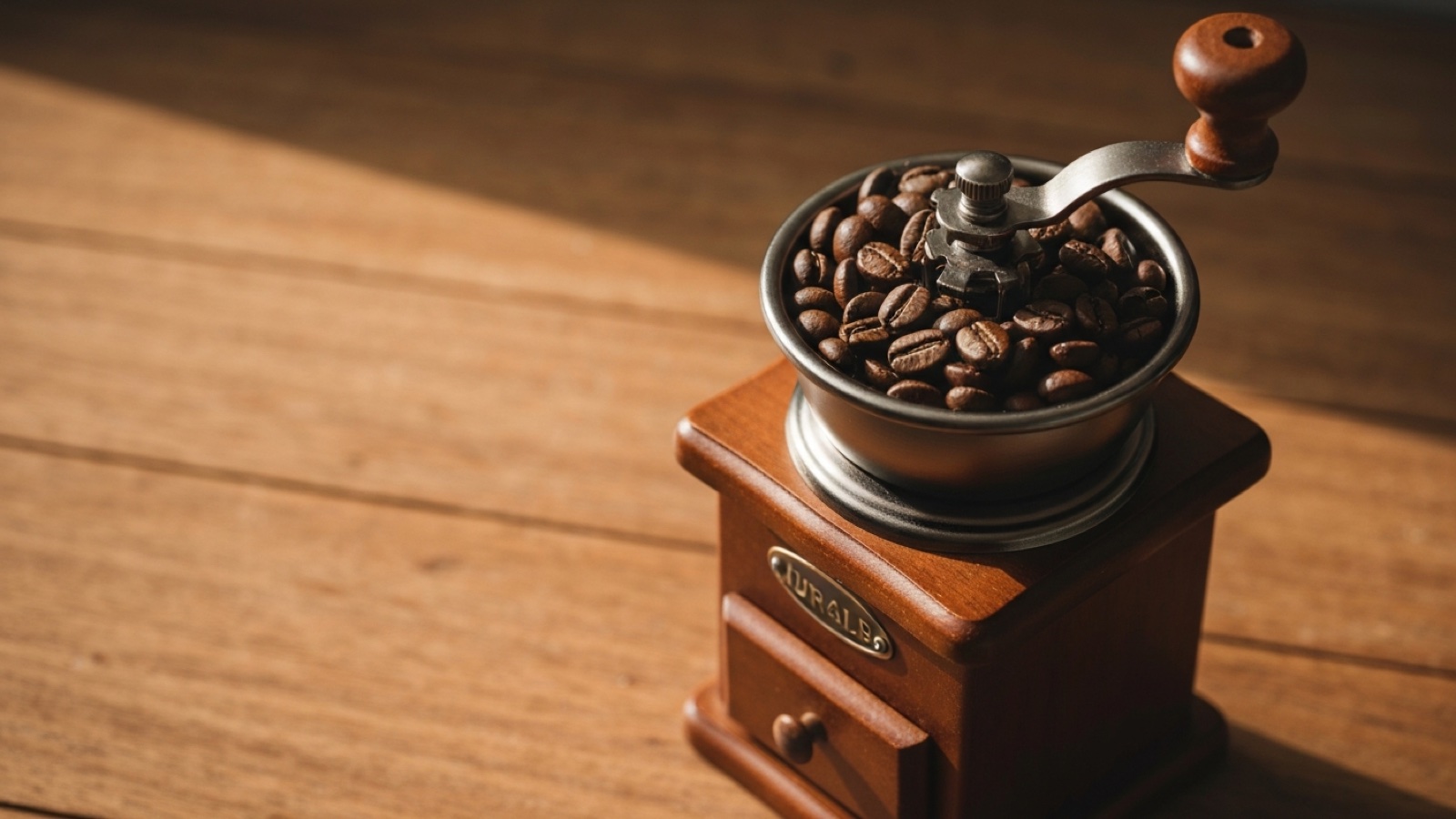
Hand grinders have closed the gap with electric grinders dramatically since 2018. The 1Zpresso K-Ultra at $300 and the Kingrinder K6 at $230 both produce espresso-grade grinds with particle distributions tighter than most $500 electric grinders. The workflow takes 30 to 60 seconds of cranking per dose, which is the tradeoff.
Hand grinders make sense for three primary use cases plus a handful of edge cases worth noting. Travel: the device fits in a backpack and works without electricity. Small kitchens: the footprint is roughly the size of a tall water bottle, much smaller than any electric grinder. Single-drinker households pulling one or two cups per morning: the cranking time is acceptable when the alternative is owning a $200 electric that sits on the counter.
Hand grinders do not make sense for households pulling four or more drinks per session, for users with hand or wrist issues, or for kitchens that already have counter space for an electric. The cranking time compounds across multiple cups; grinding for a French press carafe (60 grams of coarse coffee) takes 4 to 5 minutes by hand, which is more time than the steep takes. An electric does the same work in 15 to 20 seconds.
Electric grinders, in detail
Electric burr grinders are the standard for most home setups. The category spans from $170 (Baratza Encore) to $3,000 (commercial grade Mahlkonig E65S). The price-to-performance curve has three meaningful tiers.
Entry tier ($170 to $300): Baratza Encore, Fellow Opus, Baratza Virtuoso+. 40mm conical burrs, stepped adjustment, 30+ grind settings covering French press to fine drip. The Encore is not espresso capable; the Opus and the Virtuoso+ are, with some limitations. Right tier for drinkers brewing primarily pour over, drip, French press, and AeroPress.
Mid tier ($500 to $900): Eureka Mignon Specialita, Niche Zero, Baratza Vario W+. 54-63mm burrs, stepless adjustment, fine enough for espresso. The grinders that pair with $500 to $1,500 espresso machines and produce shots that approach cafe quality. The single largest leap in grinder quality happens between $300 and $600.
Commercial-adjacent tier ($1,200 to $3,500): Mahlkonig E65S, Anfim Pratica, Mazzer Mini E. 65mm to 75mm flat burrs, commercial grade build, often single dose mode optional. The grinders that pair with $2,000 to $6,500 espresso machines (La Marzocco Linea Mini, Profitec Pro 800). The drinker buying at this tier is approaching cafe-grade output and has already filed the budget under "ends the upgrade path."
Espresso-specific grinder requirements
Espresso requires a finer grind than any other brewing method, and the dose has to be evenly distributed across hundreds of microscopic channels for the pressurized water to extract consistently. Three requirements matter at the espresso boundary.
Fine grinding capability. The grinder has to reach a "fine espresso" setting that produces a powdery output without clumping. Most grinders below $200 cannot reach this consistently; the burr gap is calibrated for the wider range needed for pour over and drip. The Encore ESP variant (espresso-modified $200 version of the Baratza Encore) is the cheapest grinder that pulls real espresso. Below that price, the Cuisinart and Krups blade-and-burr units fail at espresso fineness.
Stepless or finely calibrated adjustment. Espresso grind sensitivity is measured in clicks of one or two. A stepped grinder with 30 settings (Baratza Encore) cannot dial in espresso precisely because the steps are too coarse at the fine end. A stepless grinder (Eureka Mignon, Niche Zero) lets the drinker make micro-adjustments and find the sweet spot for a specific bean. The Fellow Opus uses 41 stepped settings, which approaches stepless precision at the fine end.
Low retention. Espresso grinding leaves coffee inside the grinder; the next dose includes some of the previous bag’s leftover grounds. Old grounds are stale grounds, which contaminate the next shot. The Niche Zero pioneered the single-dosing category with near-zero retention (the grinder dumps almost all of the dose out, leaving fractions of a gram inside). Lower-retention grinders produce cleaner shot-to-shot consistency, especially during bean changes.
The grinder budget rule of thumb
At the home espresso tier, the grinder should cost at least as much as the machine. A $500 espresso machine pairs with a $500 to $800 grinder. A $1,500 machine pairs with a $1,000 to $1,500 grinder. Above $2,000 in machine, the grinder budget can equal the machine without diminishing returns. This rule is consistent across third wave specialty literature and matches the pillar guide on The Espresso Machine Buying Guide.
For pour over, drip, French press, and AeroPress, the budget rule is less strict. A $170 Baratza Encore paired with a $25 V60 produces excellent pour over. The Baratza Virtuoso+ at $300 improves the cup measurably, but the Encore is the working floor. Above $400 in pour over grinder, the returns flatten quickly; the Niche Zero at $800 produces marginally better pour over than the Encore at $170, but the leap is small compared to the espresso-side improvement.
The grinder vs machine tradeoff
Many home espresso buyers face a budget decision: a $1,000 machine with a $200 grinder, or a $500 machine with a $700 grinder. The third wave consensus is the second option. The grinder limits the cup more than the machine does at this price tier. A $500 Breville Bambino with a Niche Zero pulls better shots than a $1,500 Profitec Pro 300 with a Baratza Encore ESP.
The reasoning is that the espresso machine’s job is to control temperature and pressure for 25 to 30 seconds. Most machines above $500 do this acceptably; the marginal improvements at the $1,000+ tier are temperature stability, steam wand quality, and build durability rather than cup quality. The grinder’s job is to produce particles of the right size and distribution, and this is much harder to do well. The variation between $200 and $800 grinders is larger than the variation between $500 and $2,000 espresso machines, in terms of effect on the cup.
For a drinker on a $1,000 total budget, the right split is roughly $400 on the machine (Breville Bambino, Lelit Anna) and $600 on the grinder (Niche Zero, Eureka Mignon Specialita).
Common grinder mistakes
Buying the integrated machine grinder. Espresso machines with built in grinders (Breville Barista Express, Barista Pro, Barista Touch) save counter space but constrain the upgrade path. The integrated grinder shares heat with the boiler and produces inconsistent grinds during long sessions. A standalone grinder is almost always the better long term choice. The exception is the Breville Oracle Touch ($2,500), which integrates a commercial grade grinder.
Not cleaning the burrs. Coffee oils accumulate on the burrs across months of use. The buildup affects grind consistency and slowly degrades the cup. Grinder cleaning tablets (Urnex Grindz, Cafiza) clean the burrs without disassembly; run a tablet through every 6 to 8 weeks of daily use. Most users skip this step and wonder why their grinder feels slower or less consistent over time.
Grinding too far in advance. Ground coffee oxidizes within hours, not days. The drinker who grinds a week’s worth of coffee on Sunday is brewing stale coffee by Thursday. Grind immediately before brewing for every cup. The 30 to 60 seconds of grinding time is worth the freshness.
Mismatching grind setting to brewing method. The same grinder produces different particle sizes across its range. French press requires coarse (cane sugar texture). Pour over requires medium fine (table salt). AeroPress requires medium to medium fine. Espresso requires fine (powder, just past flour). Drip requires medium (slightly coarser than pour over). A drinker switching brewing methods has to adjust the grinder accordingly.
Single dose vs hopper-fed grinding
Two workflows dominate home grinding. Single dose loads the exact gram amount needed for the brew into the top of the grinder, grinds, and dispenses; the grinder ends each session empty. Hopper-fed keeps a 200 to 500 gram bean reservoir in the grinder, with each session pulling beans from the hopper into the burrs as the dose is dispensed.
Single dose is the third wave default. The advantages: fresher coffee (beans in the hopper oxidize against airflow), bean rotation (a household pulling both espresso and pour over can switch beans without purging the hopper), and exact dose control (no over-grinding waste). The disadvantage: slower workflow (the user weighs in beans for each shot rather than just pressing a button).
Hopper-fed is the traditional cafe approach scaled to home. Faster workflow, less per-shot weighing. The tradeoff is bean staleness in the hopper across days, and inability to swap beans without manual purging. Most consumer-grade grinders ship with both modes available; the Baratza Encore, Fellow Opus, and Eureka Mignon Specialita all support either workflow.
14 day free trial. Real PayPal cash on every coffee run.
The Niche Zero pioneered the modern single-dose-only grinder, with a small loading cup that holds 18-22 grams (one to two doses) and dumps cleanly into the burrs. Subsequent single dose grinders (DF64, Lagom Mini, Solo, Kafatek) have followed the same architecture. For drinkers running multiple beans (one espresso blend, one single origin pour over), the single dose workflow is clearly better.
The retention problem in depth
Retention is the amount of ground coffee left inside the grinder after a session. Low-retention grinders dump out almost all of the dose; high-retention grinders trap 1 to 3 grams in the burr chamber, the chute, and the spout. The trapped coffee matters because it stays inside between sessions and gets dispensed as part of the next dose, which means each shot includes a few grams of stale grounds from the previous bag.
For drinkers pulling the same bean every day, retention is a minor issue. The trapped coffee is the same as the current bag, and the staleness penalty is small. For drinkers swapping beans frequently, retention is a real problem. Switching from a Stumptown Hair Bender to a Counter Culture Apollo with a 2-gram retention grinder means the first 2 to 4 shots of the new bag are contaminated with stale Hair Bender. Most users do not notice the contamination consciously but taste the cup as "off" for a few shots.
Single dose grinders solve retention by design. The Niche Zero retains 0.1 to 0.3 grams across an 18-gram dose, low enough that bean-to-bean contamination is negligible. Hopper-fed grinders retain 0.5 to 3 grams depending on the model and the burr cleanliness. The single dose category exists largely because retention became a measurable problem once drinkers started swapping beans frequently.
The grinder for cold brew
Cold brew uses the coarsest grind of any common method, similar to raw cane sugar between two fingers. Most burr grinders handle this grind cleanly; the Baratza Encore, Fellow Opus, and 1Zpresso K-Ultra all reach coarse settings without issue. Hand grinders are particularly good for cold brew because the slow cranking gives even pressure across the bean, producing a tighter coarse distribution than some entry-level electrics.
Specialty cafes running cold brew programs often use a separate dedicated grinder for the coarse setting, partly to avoid re-dialing across the day and partly because cold brew batches use much larger doses (125 to 250 grams) than other methods. A drinker brewing cold brew at home weekly should not need a dedicated cold brew grinder; the same Baratza Encore handles cold brew on Sunday and pour over Monday through Saturday without complaint.
For the full cold brew method and gear list, see Pulled’s pillar guide on Cold Brew vs Iced Coffee vs Nitro, Explained.
The first grinder vs the upgrade grinder
For a drinker buying their first burr grinder, the question is whether to optimize for the current brewer or plan for the future brewer.
Optimize for current: Buy the Baratza Encore at $170 if the current setup is pour over, drip, French press, or AeroPress. The Encore is fine for those methods and the savings can go toward better beans or other gear. Plan to upgrade in 2 to 3 years if espresso enters the picture.
Plan for future: Buy the Fellow Opus at $200 or the Eureka Mignon Specialita at $640 if espresso is on the 12-month horizon. Both grinders handle all brewing methods now and grow with the drinker as the brewing range expands. The Specialita is overkill for pour-over-only households but pairs perfectly with any espresso machine from $400 to $2,000.
The right choice depends on certainty about future brewing. A drinker who knows they will buy an espresso machine within the year should buy the Specialita or similar now and avoid the upgrade later. A drinker who is happy with pour over and has no espresso ambitions should buy the Encore.
Travel grinder strategies
Drinkers who travel for work or pleasure need a portable grinding solution. Two paths work.
The dedicated travel grinder. A 1Zpresso K-Ultra ($300) or Kingrinder K6 ($230) packs into a checked bag, weighs under a pound, and produces grinds equivalent to a $500 electric. Both grinders fit easily in carry-on luggage and pass TSA inspection without issue. The tradeoff is the cranking time (30 to 60 seconds per dose). Useful for road trips, hotel stays, and Airbnb cooking where the kitchen does not have a grinder.
The dual-purpose hand grinder approach. A drinker living in a small apartment who also wants travel capability can buy a 1Zpresso K-Ultra as their primary home grinder. Same workflow, same output quality, just slower than electric. For households pulling 1 to 2 drinks per morning, the dual-purpose hand grinder eliminates the need to own both a home electric and a travel device.
The weight vs scoop question
The single biggest workflow upgrade after switching to a burr grinder is switching from volume measurement (scoops, tablespoons) to weight measurement (grams). A scoop of light roast coffee weighs less than a scoop of dark roast coffee even at the same grind setting, because the lighter beans are denser and pack tighter. A scoop of fine grind weighs more than a scoop of coarse grind from the same beans, because the fine grounds pack more tightly into the same volume.
The result is that volume-based measurement produces shot-to-shot variation of 10 to 20 percent in actual coffee mass, which is loud enough in the cup to change extraction noticeably. A 0.1g brewing scale ($25 from Hario, Brewista, or TIMEMORE) eliminates the variation. Weigh the dose into the portafilter or the brewer; the grinder dispenses to the gram once the scale catches up.
Some grinders include built in scales (the Acaia Lunar weighs to 0.1g directly under the portafilter; the Mahlkonig E80 has an integrated scale). For drinkers buying a separate brewing scale, the same scale works across espresso, pour over, and cold brew. The investment is permanent and pays back on every shot through tighter cup consistency.
Replacement burr economics
Burrs are the wear part in every grinder. Conical burrs wear faster than flat burrs because they spin against each other under more contact pressure. Flat burrs wear from heat and friction at the contact edge. Most home grinders need burr replacement every 200 to 800 pounds of coffee depending on the model and the usage pattern.
Replacement burrs run $20 to $80 for consumer grinders (Baratza Encore $20, Eureka Mignon $40-60, Niche Zero $50) and $80 to $200 for commercial-adjacent grinders (Mahlkonig E65S, Anfim Pratica). Installation is typically a 10 to 20 minute job with a screwdriver, no special tools required. Baratza in particular publishes detailed video guides for burr replacement; the company sells the parts directly through their service site.
A drinker pulling 2 to 3 shots per day uses roughly 30 to 45 pounds of coffee per year, which means burr replacement every 6 to 18 years for most home grinders. The replacement is a small fraction of the original grinder cost amortized across a long service life. The cost-per-cup of burr ownership is negligible compared to the cost of the beans being ground.
How long a good grinder lasts
Burr grinders are long-lived appliances with replaceable parts. The motors in electric grinders last 7 to 12 years of daily use. The burrs themselves wear down over 200 to 800 pounds of coffee, which works out to 4 to 16 years for most home users. Replacement burrs run $20 to $80 depending on the grinder and are user-installable in most models.
Hand grinders last longer because the mechanical wear is on the bearings rather than a motor. A 1Zpresso K-Ultra used daily for 10 years still works; the burrs may need replacement at the 7 to 8 year mark depending on usage.
The longest-lived grinders are commercial grade units like the Mahlkonig E65S or the Mazzer Major, which can run for 15 to 20 years of daily use with routine burr replacement every 5 to 7 years. The upfront cost is higher but the cost-per-cup across the lifespan is lower than rotating through three or four mid-tier grinders.
Questions readers ask
Is the Baratza Encore good enough for espresso? The base Encore is not. The Encore ESP variant ($200) is a modified version of the Encore with espresso capable fineness; it pulls acceptable espresso on entry-level machines. For better espresso, the Fellow Opus ($200) or the Eureka Mignon Specialita ($640) are clearer paths.
Can a single grinder handle both pour over and espresso well? Yes, with stepless or finely calibrated adjustment. The Fellow Opus, Eureka Mignon Specialita, and Niche Zero all switch between pour over and espresso grind settings cleanly. The tradeoff is that switching requires re-dialing on both sides; a drinker brewing both methods daily often keeps two grinders, one for each.
Why is the Niche Zero $800? 63mm Mazzer Kony burrs (used in commercial machines costing 3x as much), single dose hopper with near-zero retention, stepless infinite adjustment, and a build quality that lasts 15 to 20 years. The Niche launched in 2018 and produced the modern home single-dosing category by itself. The price is justified by the burr size, the engineering, and the longevity.
Should the grinder pair with a specific espresso machine? Within reason, no. Any 58mm portafilter machine works with any espresso capable grinder. The pairing question is about cup quality rather than mechanical compatibility. A Niche Zero on a $400 Breville Bambino produces excellent shots; the same grinder on a $6,500 La Marzocco Linea Mini produces marginally better shots. The grinder limits more than the machine does.
How often should the burrs be cleaned? Every 6 to 8 weeks of daily use, using grinder cleaning tablets (Urnex Grindz, Cafiza). The tablets run through the grinder like coffee and absorb oils and old grounds. Skip the cleaning and the cup quality degrades quietly over months.
Is a Cuisinart or Krups blade-and-burr unit acceptable? Only at the lowest budget tier. The grind consistency falls well below the Baratza Encore at the same price ($60 to $90), and the durability is poor. A drinker on a $100 grinder budget should buy a used Baratza Encore on eBay rather than a new Cuisinart.
The five picks at a glance
Baratza Encore ($170): entry electric, pour over and drip and French press. Not espresso capable.
Fellow Opus ($200): compact electric, all brewing methods including espresso, near-silent motor.
1Zpresso K-Ultra ($300): travel-ready hand grinder, all methods including espresso, no electricity needed.
Eureka Mignon Specialita ($640): mid-tier espresso electric, stepless adjustment, the sweet spot for serious home espresso.
Niche Zero ($800): single-dosing enthusiast electric, 63mm Mazzer burrs, the upgrade that ends most grinder questions across a full home brewing range.
Practical takeaway
The grinder is the budget line most home coffee buyers under-invest. Spend more on the grinder than feels intuitive. A $200 grinder with a $25 V60 produces better pour over than a $200 V60 setup with a $25 grinder. A $700 grinder with a $400 espresso machine produces better espresso than a $400 grinder with a $1,500 espresso machine. The grinder limits the cup more than any other piece of equipment, and the upgrade to a quality burr grinder is the largest single cup quality improvement most home drinkers can make.
Pulled exists so the cafe pouring the reference cup is findable from any city, and the home setup is what brings that cafe-quality cup into the kitchen on the mornings the cafe is not an option. The right grinder is the foundation that makes the rest of the home setup pay off, and the upgrade from blade to burr is the largest single quality leap available to most home drinkers. Start at the Baratza Encore, finish at the Niche Zero, and the cup quality through that arc covers every meaningful brewing decision a 2026 home setup will face. Find cafes pouring the reference cup at the Pulled Coffee Map.
Earn cash on every coffee run. Download Pulled.
Our Picks
What we'd buy on Amazon for this
Hario · Mini Mill Slim Plus Manual Hand Grinder
Ceramic burrs, fits in a backpack pocket. The starter hand grinder.
$38.50
View on Amazon →Timemore · Chestnut C2 Manual Hand Grinder
Steel burrs at the price of ceramic competitors. Pour over and french press champion.


Pulled may earn a commission on purchases. Cookie applies to all Amazon items in your next 24 hours, not just this product.
See all Pulled Picks →Keep going with Pulled