May 22, 2026
Iced Latte Recipe: How to Make One at Home in 4 Minutes
An iced latte is two shots of espresso poured over cold milk and ice. That is the recipe. Everything after that is preference: which milk you use, how much syrup goes in, whether you pull fresh espresso or steep cold brew the night before. This guide gives you the method, the ratios, the calorie numbers, and the reason a homemade iced latte costs about a dollar while the same drink runs $5.45 across the counter.
The recipe
This makes one 12-ounce iced latte. Prep time is 3 minutes. Pulling the espresso takes about 1 minute. Total time is 4 minutes, start to finish.
Iced latte ingredients:
- 2 shots of espresso (about 2 ounces), or 1/2 cup of strong cold brew concentrate
- 6 ounces of cold milk
- 1 cup of ice
- Optional: 1/2 to 1 tablespoon of vanilla, caramel, or hazelnut syrup
Method:
- Pull two shots of espresso into a small cup.
- Fill a 12-ounce glass to the top with ice.
- Pour the cold milk over the ice.
- Add syrup now if you want it, and give it a quick stir.
- Pour the hot espresso over the ice and milk.
- Stir once. Drink it cold.
That sequence matters more than it looks. The next section explains why the order is doing real work.
The espresso-first method, poured last
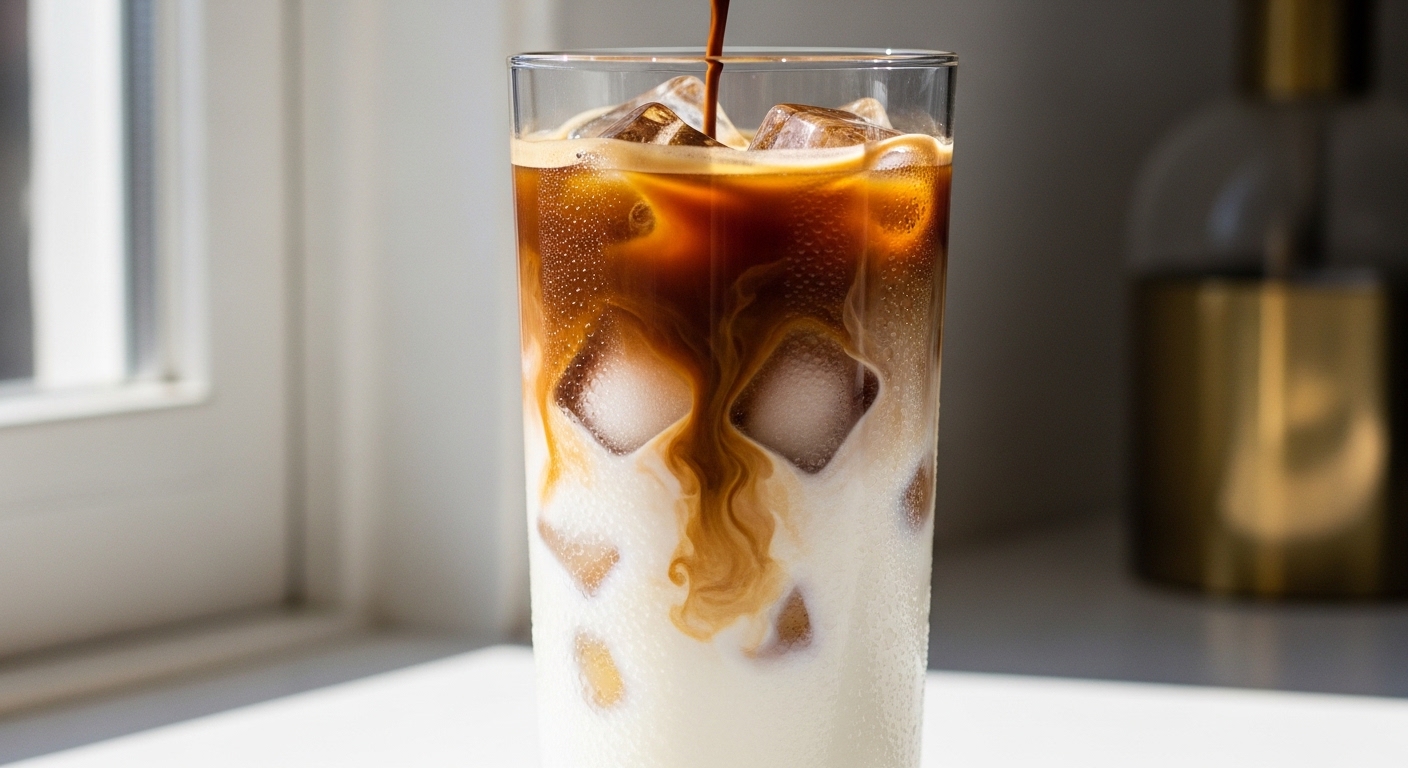
Pull the shots first, but pour them into the glass last. Hot espresso hitting bare ice melts it fast and waters down the drink. Hot espresso hitting cold milk over ice cools on contact, so the ice survives and the latte stays concentrated.
Here is the full logic of the order. Ice goes in first so the glass is cold before anything else touches it. Milk goes in second because it needs the ice to chill it and because it gives the espresso something cold to land on. Espresso goes last and gets poured slowly over the back of a spoon or straight down the side, which gives you that layered look for a second before you stir. Pulling the shots into a separate cup first means they are ready to go the moment the glass is built, so they spend the least possible time hot.
You do not need a $700 machine for this. If you own an espresso machine, great, it is a 4-minute drink. A stovetop moka pot makes about 2 ounces of strong coffee that stands in for espresso cleanly. An Aeropress pulled short and concentrated also works. The base just needs to be small and strong.
The cold brew variation
No espresso machine, no moka pot, no problem. Cold brew is the easiest base for a homemade iced latte, and it is the one most people land on once they make it twice.
Steep 1 cup of coarse-ground coffee in 4 cups of cold water for 12 to 18 hours in the fridge. Strain it through a paper filter or a fine mesh. What you have left is cold brew concentrate. Use 1/2 cup of that concentrate in place of the two espresso shots, pour it over the ice and milk, and you have an iced latte with no hot step at all.
Cold brew changes the flavor. It is smoother and lower in acid than espresso, with a rounder, chocolatey edge instead of the bright snap a fresh shot gives you. It is also stronger than people expect: a half cup of concentrate can carry 150 to 200 milligrams of caffeine, sometimes more. Make a batch on Sunday and you have five iced lattes ready to build through the week in under a minute each. For most people working from home, this is the version that sticks.
Milk choice changes the drink more than the coffee does
The milk is half the drink by volume, so it drives the texture and most of the calories. Here is what 6 ounces of each option does.
- Whole milk: about 110 calories. The richest mouthfeel, a faint natural sweetness, the closest thing to a cafe iced latte. This is the default for a reason.
- 2 percent milk: about 90 calories. Lighter body, still creamy. A reasonable middle ground.
- Skim milk: about 60 calories. Thin in the mouth and a little watery against ice, but the lowest dairy-calorie option.
- Oat milk: about 90 calories for standard oat, closer to 130 for barista blends. Oat is the non-dairy milk that holds its body best over ice. It tastes faintly sweet and oaty and pairs well with espresso.
- Unsweetened almond milk: about 25 calories. The lightest by far. It thins out against the coffee and adds a nutty note, which some people like and some do not.
Whole milk and oat milk are the two that taste closest to what you buy out. Skim and unsweetened almond are the two that cut the calories hardest. If you are building a homemade iced latte to save both money and calories, unsweetened almond with a single shot is the floor, and whole milk with two shots and a syrup is the ceiling.
Syrups and the calorie math
Flavored syrup is where an iced latte quietly turns into dessert. The math is simple. One tablespoon (1/2 ounce) of standard coffee syrup adds about 20 calories and 5 grams of sugar. Vanilla, caramel, and hazelnut all land in roughly the same range.
A cafe grande gets four pumps by default, which is about 4 tablespoons, or roughly 80 calories and 20 grams of sugar before the milk is even counted. That is the gap between a 130-calorie homemade drink and a 250-calorie one. Pour your own syrup and you control it to the half tablespoon.
Sugar-free syrups exist and drop the calories to near zero, with a taste trade-off most people notice. You can also skip syrup entirely. A plain iced latte made with whole milk has a natural sweetness from the milk and the espresso that a lot of people prefer once they stop reaching for the bottle. Start with half a tablespoon, taste, and add from there. It is easier to add sweetness than to take it back out.
Adjusting the ratio for stronger or lighter
The base recipe is 2 ounces of espresso to 6 ounces of milk, a 1-to-3 ratio. Move that ratio and you move the whole drink.
For a stronger iced latte: pull a third shot, or drop the milk to 4 ounces. Three shots over 4 ounces of milk is a coffee-forward drink that still reads as a latte, not an Americano. This is the move for the morning you actually need it.
For a lighter iced latte: use a single shot, or push the milk to 8 ounces. One shot over 8 ounces of milk is mild, milky, and easy, closer to a coffee-flavored milk than a punchy espresso drink. Good for an afternoon when you want the taste without the jolt.
The ratio is the difference between a drink that wakes you up and a drink that just tastes nice. Keep the espresso fixed and change the milk, or keep the milk fixed and change the shots. Either lever works. Write down the version you like so you can make it the same way twice.
Caffeine: about 150 milligrams
A standard iced latte with two shots of espresso carries about 150 milligrams of caffeine. One shot is roughly 75 milligrams. A cold brew version made with 1/2 cup of concentrate runs higher, often 150 to 200 milligrams, because cold brew is dense.
For reference, a 12-ounce cup of drip coffee is about 120 to 150 milligrams, and a can of cola is about 35. So a two-shot iced latte sits right around a strong cup of coffee, not above it. The milk and ice do not change the caffeine. Only the number of shots, or the amount of cold brew, moves that number. Want less? Pull one shot. Want more? Pull three. The caffeine tracks the coffee and nothing else.
Calorie variations at a glance
Here is the full calorie spread for a 12-ounce iced latte, built from the numbers above.
- Lowest: one shot, unsweetened almond milk, no syrup. About 50 calories.
- Light: two shots, skim milk, no syrup. About 65 calories.
- Standard: two shots, whole milk, no syrup. About 110 calories.
- Cafe style: two shots, whole milk, one tablespoon of syrup. About 130 calories.
- Dessert end: two shots, whole milk, four pumps of syrup. About 190 calories.
The drink scales from a near-zero indulgence to a light dessert based on two choices: the milk and the syrup. The espresso itself adds almost nothing, about 5 calories for two shots. Build the version that fits the day you are having.
Iced latte vs iced coffee with milk
People use the two names like they are the same drink. They are not, and the difference is the base.
An iced latte starts with espresso or cold brew concentrate: a small, concentrated coffee base built mostly of milk. An iced coffee starts with regular brewed coffee, the kind you make in a drip machine or a pour-over, then chilled and poured over ice with a splash of milk. One is milk-forward and built on a concentrate. The other is coffee-forward and built on brewed coffee that already has water in it.
The result tastes different. An iced latte is creamy, smooth, and rounded, with the milk softening the coffee. An iced coffee with a splash of milk is brighter, thinner, and more clearly coffee, because there is more water in the cup and less milk. An iced latte also tends to carry more concentrated caffeine per ounce, since espresso and cold brew are denser than drip. Neither is better. They are two different drinks that happen to share a glass and a bag of ice.
What it costs at home vs Starbucks
This is the part that adds up. A grande iced latte at Starbucks runs about $5.45 in most markets, more in big cities and a little less in some. Build the same drink at home and the ingredients cost about a dollar.
The home breakdown: the espresso costs about 60 cents in beans, the 6 ounces of milk costs about 30 cents, a tablespoon of syrup costs a few cents, and the ice is effectively free. Call it a dollar, round up, and you are still under $1.20 for a drink that tastes like the one you paid five and a half for.
The gear pays for itself fast. Even a $200 espresso machine clears its own cost in about 45 drinks, which is nine weeks at one a workday. After that, every iced latte is straight savings. Cold brew is cheaper still, since it needs no machine at all.
$4.50 delta. Five times a week. $1,170 a year if an iced latte is your daily.
Get paid for the iced lattes you do buy out
Some mornings you are not making it at home. You are in line, the drink is $5.45, and you are buying it anyway. Pulled is a coffee discovery app that pays you real cash by PayPal for orders you already place. You log the drink, you get paid, and the money lands in your account.
It works at the places you actually go: Starbucks, Dunkin, independent third wave roasters, and the espresso program at the gas station off the highway. You do not change where you buy. You just get something back for it.
Earn up to $10,000 exploring coffee.
Make your iced latte at home on the days you can. Let Pulled cover the days you cannot.
Get Pulled.
Our Picks
What we'd buy on Amazon for this
Breville · Bambino Plus Espresso Machine
A reasonable entry point at $300 less than the Barista Pro.
$488
View on Amazon →Breville · Milk Cafe Electric Frother
Induction heated, temperature programmable. Worth it if you make milk drinks every day.
$199.95
View on Amazon →Breville · Barista Pro Espresso Machine
The machine the Pulled editorial team uses for everything.
$849.95
View on Amazon →


Pulled may earn a commission on purchases. Cookie applies to all Amazon items in your next 24 hours, not just this product.
See all Pulled Picks →Keep going with Pulled