May 13, 2026
Iced Latte vs Iced Coffee vs Iced Americano: The Real Difference
Some links in this guide are affiliate links. If you buy through them, Pulled may earn a commission at no extra cost to you. Our recommendations are based on editorial judgment and coffee culture knowledge, not commission rates.
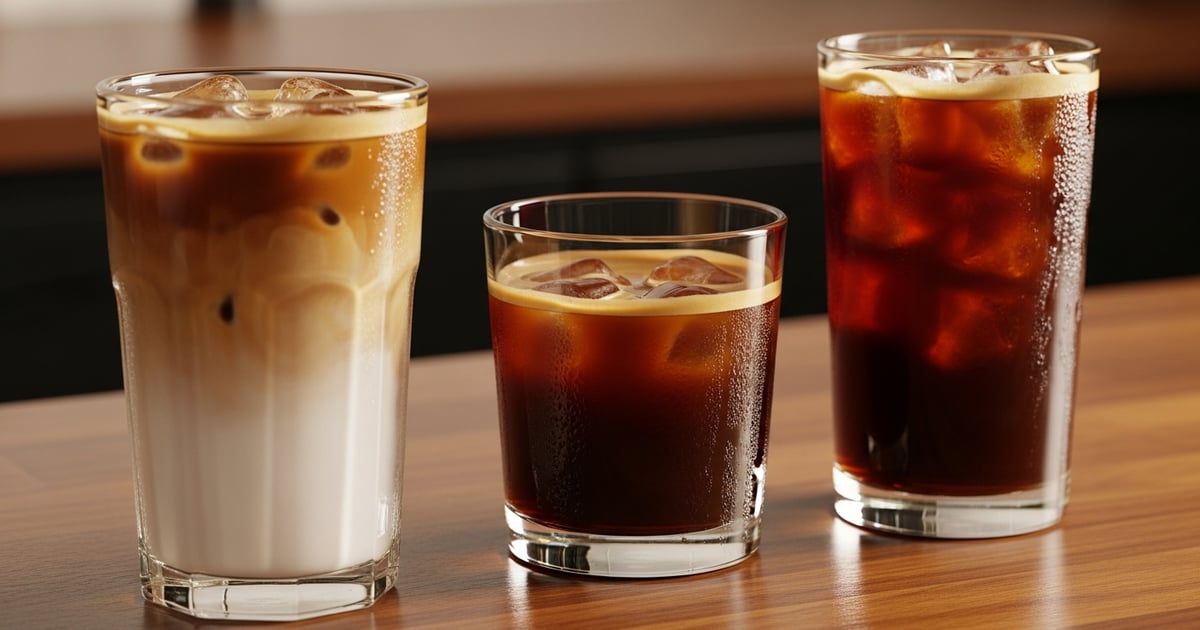
Three iced coffee drinks share the summer menu at most cafes and the differences between them are not obvious to the customer ordering or always to the barista pouring. An iced latte is espresso shaken or poured over ice with cold milk. An iced Americano is espresso topped with cold water over ice, no milk. Iced coffee is brewed coffee chilled and served over ice. The drinks taste different, use different ingredients, and cost different amounts; ordering the wrong one is a common reason a drinker thinks they do not like iced coffee. This post breaks down what each drink actually is, how the cafe builds it, and which one is right for which morning. Internal link to Cold Brew vs Iced Coffee vs Nitro, Explained for the cold-coffee category architecture.
The short version of the comparison. Iced Americano is the lightest body, the cleanest cup, and the most espresso-forward. Iced latte is the milkiest, the sweetest, and the most coffee shop classic. Iced coffee depends on the brewing method (hot brewed and chilled is bright; flash iced from a pour over is brighter still; cold brew is mellower and lower-acid). The three drinks are not interchangeable, and the right one depends on the bean, the cafe, and the drinker’s morning.
Iced latte, defined
An iced latte is two ounces of espresso (one double shot, sometimes a triple) poured over ice with 8 to 12 ounces of cold milk. The drink is built in the cup: ice first, espresso poured directly over the ice, then milk poured on top. Some bars shake or stir to integrate the espresso into the milk; most do not, leaving the customer to swirl the drink before sipping. The drink is roughly 12 to 16 ounces total depending on the cafe’s standard size for the iced latte format.
The standard milk is whole dairy. Oat milk has become the leading non-dairy option since 2018, with Oatly Barista Edition being the most common. Almond, soy, and coconut milk all work but produce different mouthfeels. Oat milk is the closest dairy substitute for the iced latte specifically because it foams less and pours cleaner over ice than the alternatives.
The flavor profile of an iced latte is milk-forward, with the espresso providing the bottom note. The drink reads as creamy and slightly sweet (from the milk lactose, even unsweetened) with chocolate and caramel notes from the espresso. The drink is the most accessible iced coffee for new drinkers because the milk masks any bitter notes that might otherwise dominate.
An iced latte at a third wave cafe costs $5.50 to $7 depending on the city. The same drink at Starbucks runs $4 to $5 in 16oz (Grande) format. The price difference reflects the bean (specialty espresso vs Starbucks proprietary blend), the milk (the cafe often uses local dairy or Oatly Barista), and the labor (the third wave barista pulls the shot and pours individually, while Starbucks uses Mastrena automated machines).
Iced Americano, defined
An iced Americano is a double shot of espresso topped with cold water over ice. No milk. The drink is built in two steps: ice and water first (4 to 8 ounces of cold filtered water, depending on the cafe’s recipe), then the double shot poured directly into the water-ice mixture. The drink is roughly 10 to 14 ounces total.
The flavor profile is espresso-forward with the water diluting the concentration to drink-strength. The drink reads as clean, bright, and slightly bitter, with the espresso’s origin character coming through clearly. A washed Ethiopian iced Americano tastes of citrus and jasmine; a natural Brazilian iced Americano tastes of milk chocolate and brown sugar. The drink is the closest summer equivalent to a hot espresso shot.
The Americano (hot or iced) was reportedly named during World War II when American soldiers in Italy asked Italian baristas to dilute the local espresso (which they found too strong) with hot water. The result was a drink that resembled American drip coffee in strength but retained the espresso flavor. The iced version followed in the 1990s and 2000s as cold coffee culture grew in the US.
An iced Americano at a third wave cafe costs $4.50 to $6, slightly cheaper than an iced latte because the drink uses no milk. The cup quality is more variable than an iced latte because the espresso has no milk to mask flaws. A weak or stale shot reads loud in an iced Americano.
Iced coffee, defined
Iced coffee is brewed coffee served over ice. The drink is more variable than iced latte or iced Americano because "iced coffee" covers three different brewing approaches that produce noticeably different cups.
Hot brewed and chilled. The cafe brews a normal hot batch (drip or pour over), lets it cool, and serves over ice. The drink is acceptable but loses brightness during the cooling step because aromatic compounds volatilize at room temperature. Most chain cafes use this approach because it allows pre-batching for high volume.
Flash iced (Japanese iced coffee). The cafe brews a hot pour over directly onto ice in the carafe. The hot water extracts the bright aromatic compounds, the ice traps them instantly by chilling the brew, and the cup retains the origin character of a hot pour over with the chill added. Third wave cafes use this approach for single origin iced coffees.
Cold brew. The cafe steeps coffee in cold water for 12 to 24 hours. The cup is sweet, low-acid, and mellow because the cold extraction never pulls the brighter acidic compounds. Most cafes list cold brew separately from iced coffee on the menu; some chain cafes use the terms interchangeably and confuse the customer.
The standard iced coffee at a third wave cafe is the flash iced (Japanese method) version. At Stumptown, Heart, or Counter Culture, ordering "iced coffee" gets the drinker a flash iced single origin pour over served in a glass over fresh ice. The cup is bright, clean, and unmistakably the same coffee a hot pour over would have made. The price runs $4 to $6 for 12oz at most cafes.
The standard iced coffee at a chain cafe (Starbucks, Dunkin’) is the hot-brewed-and-chilled version. The cup is acceptable but flatter than the flash iced version. The price runs $3.50 to $5 for 16oz to 24oz.
How the cafe builds each drink
Watching a barista build the three drinks reveals the workflow differences.
Iced latte (45 to 90 seconds): Fill cup halfway with ice. Pull double shot of espresso (25 to 30 seconds). Pour espresso directly into ice. Pour cold milk to fill the cup. Pop a lid on. Hand to customer. The drink is fast and high-margin because the barista produces 40 to 60 per hour at peak.
Iced Americano (60 to 90 seconds): Fill cup halfway with ice. Add 4 to 8 ounces of cold filtered water. Pull double shot of espresso. Pour espresso over the ice and water (some baristas reverse this and pour water over the shot for visual layering). Pop a lid on. Hand to customer. Similar workflow to iced latte minus the milk step.
Iced coffee (depends on the approach): If hot-brewed-and-chilled, the cafe pulls from a refrigerated batch in a pitcher; pour over ice, add sweetener and milk to taste at the customer’s direction. 30 to 45 seconds. If flash iced, the barista weighs the dose (23 grams), grinds, sets up the V60 over a carafe with 150 grams of ice, pours 200 grams of 93-degree water in pulses for 2:30 to 3:00. The drink takes 4 to 5 minutes total. If cold brew, the cafe pours from a tap or pitcher; the customer adds milk or water to taste.
The milk and dilution math
The drinks differ in how much liquid the customer ends up consuming and how the caffeine spreads across that liquid.
Iced latte (16oz total): 2oz espresso (60 to 80 mg caffeine) + 10oz cold milk + 4oz ice melt over 20 minutes. The caffeine is concentrated in a small volume of espresso, then diluted across the cup as the customer sips. The drink lasts 25 to 40 minutes.
Iced Americano (12oz total): 2oz espresso (60 to 80 mg caffeine) + 6oz cold water + 4oz ice melt over 20 minutes. Same caffeine load as iced latte, slightly stronger per ounce because there is no milk diluting the cup further. The drink reads as more intense even though the dose is similar.
Iced coffee, flash iced (12oz total): 8oz brewed coffee (140 to 180 mg caffeine, more than a double espresso) + 4oz ice melt. The cup carries more total caffeine than the espresso-based drinks because the brew is a full 12oz pour over rather than a 2oz espresso shot. Drinkers who feel "more wired" from iced coffee than from iced lattes are correct: the dose is bigger.
Iced coffee, cold brew (16oz total at 1:1 dilution): 8oz cold brew concentrate (200 to 260 mg caffeine) + 8oz water or milk + 4oz ice melt. The highest total caffeine of the four common iced drinks, by a margin. A drinker switching from iced latte to cold brew and not feeling the difference is unusual.
Which to order, by morning context
The right drink depends on the bean the cafe is pulling, the drinker’s caffeine target, and the morning routine.
For an espresso-quality bean and a quick stop: iced Americano. The drink lets the espresso speak with minimal interference. A washed Ethiopian or a Geisha-blend espresso shines through an iced Americano in a way no other iced format quite matches.
For a milky comfort drink and a longer sit: iced latte. The drink is creamy and lasts 30 to 40 minutes without going flat. The milk masks any espresso flaws and the drinker can sip slowly through a meeting or a long read.
For maximum caffeine and a casual mood: cold brew. The drink delivers 200+ mg of caffeine in 16 ounces and the sweet, low-acid profile sits well in the stomach for drinkers who find regular coffee acidic.
For a bright morning that wants to taste like the bean: flash iced pour over coffee (the Japanese method). The drink is the brightest of the four and shows origin character most clearly.
The shaken iced espresso variant
Starbucks released the "shaken espresso" series in 2021 to compete with Dunkin’s espresso line and capture the iced espresso category that third wave cafes had been pulling for years. The drink is a triple shot of espresso shaken with ice and a small amount of milk or simple syrup, then strained over fresh ice. The shaking introduces aeration that softens the espresso’s bitterness slightly.
Shaken espresso is functionally similar to an iced Americano with less water and more aeration. The cup reads as more concentrated than an iced Americano because the dilution is lighter (no added water), and the foam from shaking adds a mouthfeel difference that some drinkers prefer. Most third wave cafes do not offer shaken espresso as a menu item but will make one if asked.
The milk choice question
Most iced lattes are built with dairy whole milk as the default. Cold milk pours cleanly over ice without curdling or breaking. Oat milk (Oatly Barista Edition, Minor Figures Organic) is the standard non-dairy substitute and produces a similar mouthfeel. Almond milk is thinner and tends to separate over ice. Soy milk is heavier and can curdle when mixed with hot espresso, less so when the espresso has already cooled in the ice.
For iced lattes specifically, the cold temperature of the drink protects against the curdling that hot lattes face. Almond milk, coconut milk, and even some pea-protein milks (Ripple) work reasonably well in iced lattes despite being problematic in hot. The drinker should still ask the barista which non-dairy options the cafe has tested with their espresso.
The dairy choice affects calorie count significantly. A 16oz iced latte with whole milk runs 220 to 260 calories. With oat milk: 200 to 240 calories. With almond milk: 80 to 120 calories. With soy milk: 180 to 220 calories. With nonfat dairy: 120 to 160 calories. Drinkers tracking calories should know the gap; the difference between a whole-milk iced latte and an almond-milk iced latte is roughly a small banana.
The sweetener layer
Iced coffee drinks accept sweetener better than hot drinks because the cold temperature requires liquid sweeteners (sugar does not dissolve well in cold liquid). Most cafes stock simple syrup (50/50 sugar and water) for sweetening iced drinks. Some cafes offer vanilla syrup, hazelnut syrup, lavender syrup, and seasonal flavor variants.
The pour size for sweetener varies by drink. A standard iced latte gets 0.5 to 1 ounce of simple syrup (8 to 16 grams of sugar). An iced Americano takes less, usually 0.25 to 0.5 ounces (4 to 8 grams) because the smaller drink volume concentrates the sweetness. Cold brew is the sweetest of the four naturally and typically takes the least added sweetener.
Third wave cafes generally serve iced drinks unsweetened by default. The customer can request sweetener on demand. Chain cafes (Starbucks, Dunkin’) more often add a default sweetener level to menu items and require customers to ask for "unsweetened" or "no syrup" to opt out. A drinker watching sugar should specify when ordering.
The ice question
Ice quality matters more than most drinkers realize. Standard cubed ice melts in 15 to 20 minutes in a typical iced drink, diluting the cup as it goes. The drink at minute 30 tastes noticeably weaker than the drink at minute 5. Some third wave cafes use larger ice cubes (1.5-inch or 2-inch) or frozen coffee ice cubes to slow the melt rate. Coffee ice cubes (made from coffee instead of water) prevent the dilution entirely; the cube melts into more coffee instead of water.
The home version of coffee ice cubes is straightforward. Brew a batch of coffee, pour into ice cube trays, freeze. Use the cubes in iced lattes or iced Americanos. The drink stays at concentration through the full sip, which extends the usable window from 20 minutes to 45 minutes. The technique works particularly well for flash iced pour over coffee at home.
The cafe-build sequence revealed
Most third wave cafes follow a specific build sequence for iced espresso drinks that affects the final cup. The standard third wave sequence is: pre-fill cup with ice, pull espresso shot directly into the iced cup (not into a separate pitcher), then add milk or water on top. The hot espresso hits the ice and chills within 2 to 3 seconds, locking in the aromatic compounds before they can volatilize.
The alternative sequence is: pull espresso into a heated cup or pitcher, let it cool slightly, then pour over ice with milk added. This sequence is older and was the dominant approach through the early 2000s. The cup loses more aromatic compounds during the cooling step, which makes the drink less bright than the third wave sequence.
For drinkers building these drinks at home, the third wave sequence is the better approach. Pull espresso directly onto ice in the receiving glass. The flash-chilling produces a measurably brighter cup than the cool-then-pour method. The technique is the same as the Japanese iced coffee method scaled down for espresso.
The summer caffeine math
Iced drinks are often consumed at larger volumes than hot drinks. A drinker who orders a 12oz hot latte may order a 16 or 20oz iced latte for the same occasion. The volume difference compounds the caffeine load: a 20oz iced latte typically uses a triple shot rather than a double, putting the total caffeine at 95 to 120 mg compared to 65 to 80 mg in the 12oz hot version.
Cold brew is the most extreme case. A 24oz Starbucks cold brew (Venti size) delivers 360 mg of caffeine, approaching the FDA daily ceiling of 400 mg in a single drink. Drinkers who switch from iced latte to cold brew without resizing usually feel the difference within 30 minutes. The right adjustment for cold brew is to drop one size or to ask for the drink half-strength.
The Vietnamese iced coffee variant
Vietnamese ca phe sua da, also called Vietnamese iced coffee, is a category-adjacent drink worth knowing. The drink uses a small metal phin filter to drip strong Robusta coffee directly into a glass containing sweetened condensed milk, then ice is added to chill the drink as the customer stirs the condensed milk into the brew.
The cup is unmistakably different from any Western iced coffee. The drink is sweet, heavy, and powerfully caffeinated. The condensed milk replaces both the cream and the sugar layer, and the Robusta coffee gives the cup a peanut and chocolate body that washed Arabica cannot produce. The drink originated in French colonial Vietnam in the late 19th century when condensed milk was a more practical alternative to fresh milk in the tropical climate.
Most US cities with significant Vietnamese populations have cafes serving ca phe sua da in the traditional style. Trung Nguyen, Phin Cafe (in New York), Cafe Du Monde Vietnamese-style (in Houston and Dallas), and the various neighborhood Vietnamese cafes that have grown alongside the bun bo hue and pho restaurants. The drink runs $4 to $6 and is one of the highest-caffeine drinks on any cafe menu (300 to 400 mg in 16oz).
The granita and frozen variants
Coffee granita is a Sicilian frozen drink that bridges the gap between iced coffee and ice cream. Strong brewed coffee mixed with sugar is frozen in shallow trays, then scraped with a fork to break the ice into a flaky, crystalline texture. The drink is served in a glass, often with whipped cream on top, and eaten with a spoon as much as drunk. The cup runs $5 to $8 at Italian cafes and is the original frozen coffee drink.
Frappuccinos and similar blended frozen coffee drinks are the mass-market descendants of granita. Starbucks introduced the Frappuccino in 1995 (the company acquired the trademark from a Boston-area coffee shop). The drink uses pre-brewed coffee blended with ice, milk, and sugar in a commercial blender, producing a smoothie-textured cold drink. Most third wave cafes do not serve Frappuccinos; the drink is far enough from specialty coffee that the category exists as its own marketing layer.
Cold foam, the latest entry in the iced coffee variation category, is sweetened cold milk whipped to a microfoam consistency and floated on top of cold brew or iced coffee. Starbucks released the technique in 2018 and it has since spread through third wave cafes as a milk-drink option for cold drinks. The foam holds for 10 to 15 minutes before collapsing into the drink, providing the visual and the textural variation that hot cappuccinos deliver to milk-drink fans.
Where to find each drink done well
Third wave cafes excel at iced Americanos and flash iced coffee. Cafes that pull excellent espresso usually pull excellent iced Americanos because the drink is the espresso with cold water added. Cafes that have a pour over bar usually offer flash iced as an option even if it is not on the printed menu.
Iced lattes are well-made at both third wave and chain cafes; the drink is forgiving of small espresso variations because the milk masks them. The cafe difference shows up in the milk (specialty cafes use higher-fat or barista-formulated milk) and the espresso (specialty roasts produce more origin character).
Cold brew quality varies widely. The best cold brew comes from cafes that brew their own daily in small batches from named-origin specialty beans. The worst cold brew comes from cafes that use wholesale-distributed cold brew concentrate without rotation. The bag-versus-Cambro distinction is visible: small batch cold brew in a labeled Cambro container with a steep date is real; pre-bottled cold brew from a vendor distributor is not.
The Pulled Coffee Map indexes 134,000 specialty-classified shops across 41,000 cities. The specialty filter on by default catches the cafes most likely to do these iced drinks well.
Questions readers ask
Why does an iced latte taste watery by the time it is finished? The ice melt. Standard cube ice adds 3 to 5 ounces of water to the cup over 20 to 30 minutes, diluting the drink as the customer sips. The fix is to drink faster, ask for less ice (some cafes offer "easy ice"), or use coffee ice cubes at home.
Is an iced Americano the same as black iced coffee? No. An iced Americano is espresso plus cold water. Black iced coffee is brewed coffee (drip, pour over, or cold brew) served over ice without milk. The two drinks taste different: the Americano is more concentrated and espresso-forward; the iced coffee is more diluted and brewing-method-dependent.
Why is iced coffee usually cheaper than iced latte? No milk and less labor. The cafe just pours brewed coffee over ice; the iced latte requires pulling a fresh espresso shot and adding milk. The labor and ingredient cost is lower for iced coffee, and the price reflects it.
Can I order an iced cappuccino? Most cafes will make one but the drink does not work as well as iced lattes. The cappuccino’s defining feature is hot steamed milk with microfoam; cold milk cannot produce the foam structure that defines the drink. An iced cappuccino is usually built as a light iced latte (less milk than a regular iced latte) and the result is fine but not particularly cappuccino-like.
What about iced flat whites? Some Australian-influenced cafes serve iced flat whites: a double shot poured over ice with less cold milk than an iced latte (typically 4 to 6 oz vs 10 to 12 oz). The drink is more espresso-forward than an iced latte but more milky than an iced Americano. The category is small in the US but standard in Australian-influenced specialty cafes.
Is iced coffee harder on the stomach than hot coffee? The cold temperature does not change coffee’s acidity meaningfully. The chlorogenic acid content is the same regardless of brewing temperature. Drinkers who experience iced coffee differently than hot are likely responding to the volume (drinkers consume more iced coffee than hot in a single sitting) or the milk and sugar content rather than the iced format itself.
What is the longest a fresh iced coffee stays good? Flash iced pour over is best within 30 to 45 minutes; past that, the cup loses brightness even kept cold. Cold brew is good for 7 to 14 days refrigerated. Iced lattes are best within 20 to 30 minutes because the milk and ice melt change the cup quickly.
Practical takeaway
The three drinks serve different purposes and reward different ordering habits. Iced latte is the milky, sippable, casual drink for a long sit. Iced Americano is the espresso-forward, lighter-body, quick-drink option. Iced coffee is the brewing-method-dependent category that ranges from bright (flash iced) to mellow (cold brew). A drinker who likes hot espresso should default to iced Americano in summer; a drinker who likes lattes should default to iced lattes; a drinker who wants caffeine without much fuss should default to cold brew.
The right approach for most drinkers is to keep all three drinks in rotation across the warm-weather months rather than locking into a single category. Iced Americano on quick mornings before work, iced latte for longer sit-down moments with a meeting or a book, cold brew or flash iced coffee depending on the cafe’s particular strength. Treating the three drinks as interchangeable misses the point; treating them as complementary opens up a wider and more interesting summer coffee program across the season.
Pulled exists so the cafe pouring the right iced drink is findable from any city. The pillar guide on Cold Brew vs Iced Coffee vs Nitro, Explained covers the broader cold-coffee architecture; this post slots in as the espresso-based iced drinks comparison underneath. The drinker who learns the three drinks and orders deliberately gets a better cup every summer morning, which compounds across a season into a measurably different relationship with iced coffee than the typical drinker who orders by default. The right drink for the right morning is a small daily decision that adds up over a hundred summer mornings into a noticeably better relationship with iced coffee than the default ordering produces.
Our Picks
What we'd buy on Amazon for this
Breville · Bambino Plus Espresso Machine
A reasonable entry point at $300 less than the Barista Pro.
$488
View on Amazon →Breville · Milk Cafe Electric Frother
Induction heated, temperature programmable. Worth it if you make milk drinks every day.
$199.95
View on Amazon →Breville · Barista Pro Espresso Machine
The machine the Pulled editorial team uses for everything.
$849.95
View on Amazon →


Pulled may earn a commission on purchases. Cookie applies to all Amazon items in your next 24 hours, not just this product.
See all Pulled Picks →Keep going with Pulled