May 13, 2026
Pour Over vs Aeropress vs French Press: Which is Right for You
Some links in this guide are affiliate links. If you buy through them, Pulled may earn a commission at no extra cost to you. Our recommendations are based on editorial judgment and coffee culture knowledge, not commission rates.
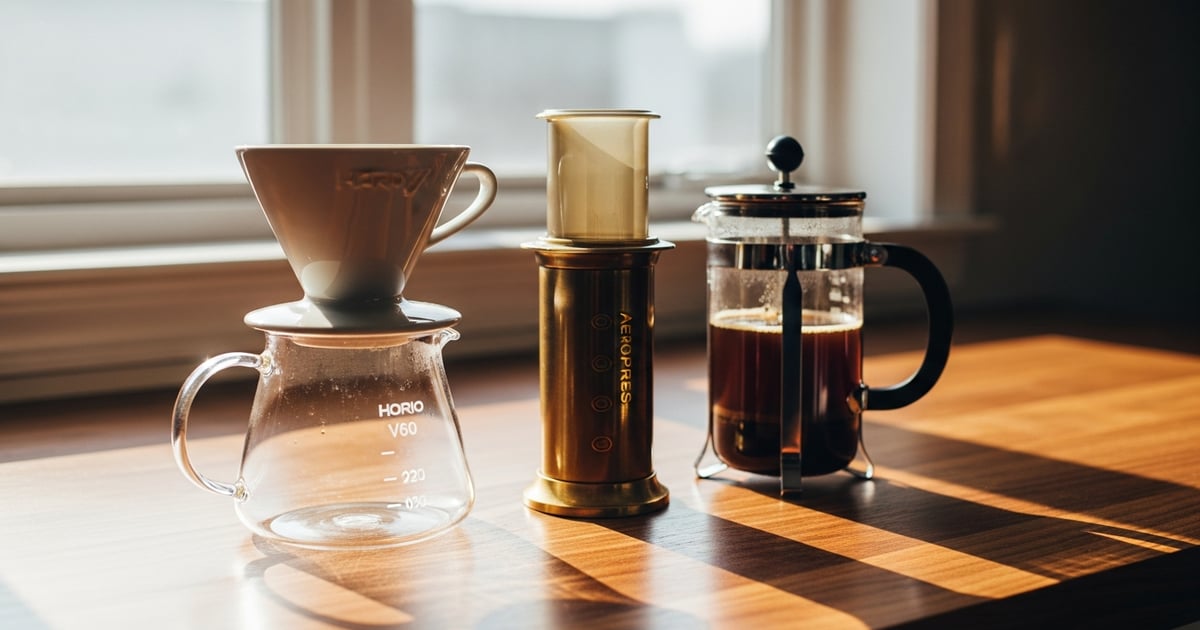
Three manual coffee brewers cover most of what home drinkers actually need. The pour over (Hario V60, Chemex, Kalita Wave) is the clarity option, brewing a light, clean, origin-forward cup. The AeroPress is the travel option, brewing a 6oz cup in 90 seconds with a workflow that fits in a hotel room. The French press (Bodum Chambord) is the body option, brewing a heavy, rich cup that espresso drinkers reach for in the morning. The three are not interchangeable. Each one solves a different problem.
This post walks through the mechanics of each method, the gear that matters, the canonical recipe, the cup profile each one produces, the audience each one fits, the maintenance each one demands, and the travel use case that often decides between them. For the deep architecture of pour over specifically, see Pulled’s pillar guide on The Pour Over Coffee Guide. The comparison below sits on top of that pillar and helps a buyer decide which manual brewer to pick first.
How the three methods actually differ
Coffee brewing is the controlled extraction of soluble compounds from ground coffee into water. The variables are grind size, water temperature, ratio, contact time, and filtration. Each method handles these variables differently.
Pour over uses gravity and a paper filter. Water passes through the grounds in 3 to 4 minutes at 93 degrees Celsius. The paper filter traps oils and fines, producing a cup that reads clean on the tongue with body closer to tea than to a French press. The grind is medium fine.
AeroPress combines immersion (steeping) with light pressure through a paper filter. The grounds sit in water for 30 to 60 seconds, then the user presses a plunger to force the brew through the filter. The brew time is 90 to 120 seconds total. The grind is medium to medium fine.
French press uses full immersion through a metal mesh filter. The grounds sit in water for 4 minutes, then a plunger pushes the grounds to the bottom of the beaker while the brewed coffee stays above. The metal mesh lets oils and fines through, producing a heavy-bodied cup. The grind is coarse.
The cup each one produces
The same beans through the three methods produce three measurably different cups. The differences are larger than most beginners expect.
Pour over. Body: light, tea like. Acidity: bright, foregrounded. Flavor: origin-forward, with the floral and fruit notes most visible. A washed Ethiopian Yirgacheffe pulled as pour over tastes of jasmine, bergamot, and lemon zest. A washed Kenyan SL28 tastes of blackcurrant and tomato leaf. The cleanest expression of the bean.
AeroPress. Body: medium, between pour over and French press. Acidity: moderate, less foregrounded than pour over. Flavor: balanced, with both origin character and body coming through. The same Yirgacheffe pulled as AeroPress tastes of stone fruit and chocolate, with the jasmine slightly muted. A natural Brazilian tastes of milk chocolate and brown sugar.
French press. Body: heavy, full. Acidity: low, in the background. Flavor: rounded, with chocolate and earth notes amplified by the oils retained in the cup. The same Yirgacheffe loses most of its floral character to the heavy body; the brightness reads as muted. A Sumatran or a dark roast Brazilian is the better French press bean choice: heavy origins shine, light origins get flattened.
Pour over, in detail
Pour over took its modern shape in 2004 when Hario released the V60 in Tokyo. The 60-degree cone, the spiraled ribs, and the single large drainage hole let the brewer control contact time through pouring rather than relying on the filter. Within five years the V60 had become the default brewing device of the third wave, used by national-champion baristas in Oslo and Melbourne and behind the counter of nearly every specialty roaster opening in the US.
The canonical V60 recipe is 18 grams of medium fine ground coffee to 300 grams of 93-degree water, brewed in 3:30 to 4:00. The bloom is 50 grams of water for 30 to 45 seconds, then two main pours up to the 300 gram target. The full protocol is covered in Pulled’s pillar guide on The Pour Over Coffee Guide.
The supporting gear matters. A 0.1g scale tracks the dose and the pour weight. A gooseneck kettle with variable temperature control holds the water at 93 degrees and lets the brewer aim the pour. A burr grinder produces the even particle distribution that even pour over extraction depends on. The Fellow Stagg EKG kettle is the standard pairing for a home pour over setup.
The technique takes practice. The first month of pour over is mostly about learning to hit the same total brew time and the same final weight day after day. Variation in technique is louder than variation in coffee. Once the brewer is consistent, the variables (grind size, water temperature, ratio, pour pattern) become real levers rather than noise.
AeroPress, in detail
Alan Adler invented the AeroPress in 2005 after watching his colleagues at Aerobie struggle with single cup drip. The first commercial production run shipped in late 2005, and the device has since become a fixture of every third wave cafe’s travel kit and the basis of an annual World AeroPress Championship that draws competitive baristas from 60 countries.
The canonical AeroPress recipe varies by user. The standard "inverted" method (used in most competition recipes) is 15 grams of medium fine coffee, 200 grams of 85-degree water, 60-second steep, 30-second press. The cup is around 6 ounces. The standard method (right-side up, as the inventor intended) brews 11 grams of coffee with 200 grams of 80-degree water in 30 seconds total, producing a more diluted cup that can be topped up with hot water for a stronger drip-style brew or pulled neat for an espresso-style concentrate.
The device is forgiving of small mistakes. The short brew time and the controlled pressure mean that grind size, water temperature, and timing can vary by 10 to 20 percent without breaking the cup. A drinker who finds pour over too finicky often switches to AeroPress and never goes back. The tradeoff is that the cup ceiling is lower than pour over; the best AeroPress brew is good but not as cleanly origin-forward as the best V60.
The travel use case is where AeroPress dominates. The device weighs 6 ounces, packs into a 4-inch tube, and brews a usable cup with nothing more than hot water from a hotel kettle. A burr grinder (or preground coffee, in a pinch) completes the kit. Most third wave coffee enthusiasts who travel for work carry an AeroPress.
French press, in detail
The French press was invented in Italy in 1929 by Attilio Calimani and refined into its current form by Bodum, a Danish company that has manufactured the Chambord since 1974. The design is mechanically simple: a glass beaker, a stainless steel mesh filter on a plunger, a metal frame. The full immersion brewing produces the heaviest body of any common method.
The canonical French press recipe is 60 grams of coarsely ground coffee to 1 litre of 93-degree water. The grind is coarser than for any other manual method: imagine raw cane sugar between two fingers. The grounds sit in water for 4 minutes, then the plunger is pressed down slowly. The brewed coffee is decanted immediately to prevent over-extraction from continued contact with the spent grounds.
The French press is the right choice for households that want coffee to taste like coffee rather than to taste like its origin. The metal mesh filter lets oils through, producing the heavy body that pour over deliberately removes. Sumatrans, Brazilians, and dark roast blends all benefit from the method; lighter washed coffees lose most of their character. For the broader picture of which beans suit which methods, see Pulled’s pillar guide on Coffee Origins: Single Origin vs Blends.
The most common French press mistake is leaving the brewed coffee in the press after the plunger is down. The spent grounds keep extracting bitter compounds across the next 20 minutes, ruining the second pour. Decant the brew into a thermal carafe immediately after pressing. The thermal carafe holds temperature for an hour without continuing extraction.
Which one is right for you
The choice depends on the drinker, the morning routine, and the bean.
Choose pour over when the drinker prioritizes origin character, has 5 minutes per cup to spare, and is willing to learn a technique. Pour over rewards careful brewing and gives back proportional results. A washed Ethiopian or Kenyan on a V60 is one of the great cups in coffee.
Choose AeroPress when the drinker travels, lives in a small space, or wants a forgiving brewing method. The AeroPress brews a respectable cup in 90 seconds with minimal cleanup. A drinker who pulls AeroPress at home can carry the same device to a hotel room, a parents’ house, or a campsite and still hit the same recipe.
Choose French press when the drinker prefers a heavy-bodied cup, drinks multiple cups per session, or wants to brew for a group. The French press scales: a 1 litre Chambord brews four 8oz cups in one go, which pour over and AeroPress cannot match. The body is the tradeoff worth paying for in this context.
Buy all three eventually. A household serious about home coffee runs all three brewers, one for each use case. The combined cost is under $200 (V60 $23, AeroPress $40, Chambord $45, plus filters), less than a single espresso machine, and the three brewers cover every cold-weather morning, summer afternoon, road trip, and dinner party. Add a Hario Mizudashi for cold brew and the kitchen is brewing-method complete.
Gear cost: the actual numbers
Pour over: $23 for the V60, $25 for a 0.1g scale, $165 for a Fellow Stagg EKG kettle (or $30 for a basic gooseneck), $170 for a Baratza Encore grinder. Full setup: $383, or $228 with the cheaper kettle.
AeroPress: $40 for the device, $25 for a 0.1g scale, $170 for a Baratza Encore grinder. Full setup: $235. No special kettle needed; a regular spouted kettle works.
French press: $45 for the Bodum Chambord, $170 for a Baratza Encore grinder. Full setup: $215. No scale needed for the basic recipe; a regular kitchen scale reading to the gram is fine. No special kettle needed.
The grinder is the constant across all three setups. A burr grinder is non-negotiable for any of the three methods; blade grinders produce particle distributions wide enough that none of the three brewers can extract evenly. The Baratza Encore at $170 is the working entry-level standard.
Common mistakes across all three
Pour over mistake: pouring too fast. The water disturbs the bed and creates channels that let water escape without extracting. The fix is to slow the pour and aim for the center two-thirds of the bed. A gooseneck kettle helps because the narrow stream lets the brewer aim precisely.
AeroPress mistake: pressing too hard. The plunger should descend slowly under steady pressure. Forcing the press creates pressure that exceeds what the filter can handle and produces a bitter, over-extracted cup. The press should take 20 to 30 seconds for 200 grams of water.
French press mistake: leaving the coffee on the grounds. Coffee left in the press after the plunger is down keeps extracting and turns bitter within 15 minutes. Decant immediately to a thermal carafe or a serving pot.
Shared mistake: stale beans. All three methods reveal stale coffee faster than drip does. Beans past 28 days off roast lose enough brightness and aromatics that the cup tastes flat regardless of technique. Buy from roasters that print the roast date on the bag and use within the freshness window.
The AeroPress recipe rabbit hole
The AeroPress has produced more recipe variations than any other brewing device. The World AeroPress Championship has run annually since 2008 in a different city each year (Oslo 2008, Copenhagen 2009, London 2010, and onwards), and each winning recipe gets published and dissected by enthusiasts. The competition has produced recipes ranging from 50-second brews to 4-minute brews, inverted to right side up, paper to metal filter, hot water to room temperature.
The Tim Wendelboe recipe (2009 winner, Oslo): 14 grams coffee, 200 grams water at 80 degrees Celsius, 60-second steep, 30-second press. Inverted method. Produces a clean cup closer to pour over than to French press.
The James Hoffmann recipe (published 2018): 11 grams coffee, 200 grams water at 95 degrees Celsius, right side up, 2-minute steep with a single swirl at 1:00, 60-second press. Produces a drip-style cup that holds up against careful pour over.
The Wendy De Jong recipe (2017 World Champion): 35 grams coffee, 50 grams water at 80 degrees, inverted, 1-minute steep, then add 150 grams water for another minute, press for 60 seconds. Produces a sweet, full bodied cup that the championship judges scored higher than the trendy lighter approaches that year.
The right approach for a beginner is to pick one recipe and stick with it for a month before iterating. The device is forgiving enough that any of the named recipes will produce a good cup; the variation between recipes is smaller than the variation between any recipe and a beginner brewing without one. After a month of consistent brewing, the drinker can swap to a different competition recipe to see how the cup changes, then settle on the one that best matches the bean and the drinker’s taste.
The Aerobie company maintains a recipe archive on the AeroPress website with the last decade of World AeroPress Championship winners. The recipes are free, the videos show technique, and the archive is the single best free coffee-education resource currently online.
Brew time per cup: the actual numbers
The total time from grinding to drinking matters for the morning routine. The three methods land in three different zones.
AeroPress: 3 to 4 minutes total. 30 seconds to grind, 30 seconds to heat water (already-hot kettle), 30 seconds to set up, 90 seconds to brew, 20 seconds to clean. The fastest of the three methods and the only one that fits in a tight morning.
Pour over: 5 to 7 minutes total. 30 seconds to grind, 1 minute to heat water and reach 93 degrees, 30 seconds to rinse the filter, 4 minutes to brew, 30 seconds to clean. Suitable for a relaxed morning, less so for a 6:45am scramble.
French press: 6 to 8 minutes total. 30 seconds to grind, 1 minute to heat water, 4 minutes to steep, 30 seconds to press and decant, 2 to 3 minutes to clean. The longest of the three, with most of the time front-loaded into the steep (which is dead time the brewer can use for other tasks).
Maintenance and longevity
All three brewers are functionally permanent. None of them have moving parts that wear out under normal use. The maintenance schedule is about cleaning, not about replacement.
Pour over. Rinse the cone after every use. Wash with soap and water weekly. Replace the paper filter every brew. A ceramic V60 lasts indefinitely; the only failure mode is breaking the cone in the sink. Plastic V60s yellow over time but keep working. Chemex carafes need glass cleaner once a month to remove water spots.
AeroPress. Rinse after every use. The plunger silicone seal lasts roughly 18 to 24 months of daily use before it starts losing its airtight fit; Aerobie sells replacement seals for $5 to $7. The full device lasts decades.
French press. Wash thoroughly after every use. The mesh filter needs careful cleaning to avoid old grounds embedding in the wires; a brush helps. The glass beaker is fragile and breaks if dropped; replacement glass beakers from Bodum cost $20 to $30 and fit the existing frame. Some heavy users break a beaker every 2 to 3 years.
The hybrid options
Three lesser-known devices combine elements of the three main methods. They deserve mention but rarely replace the primary three.
The Clever Dripper ($25) combines pour over filtration with French-press-style immersion. Coffee steeps in the cone with the bottom valve closed; the brewer opens the valve to drain through the paper filter. Cup is fuller-bodied than V60 but cleaner than French press.
The Hario Switch ($45) is functionally similar to the Clever Dripper but compatible with V60 filters. Same workflow, slightly better build quality.
The Espro Press ($90 to $150) is a double-filter French press that uses two layers of fine mesh to strip more fines from the cup. The brew sits between traditional French press and pour over on the body axis; some drinkers love it, others find it splits the difference badly.
What about pour over at scale
A 6oz V60 cup serves one drinker. A 30oz Chemex (the carafe-sized cousin to the V60, also a pour over method) serves two or three. For larger groups, the French press is the practical choice: a 51oz Bodum Chambord brews enough coffee for four to five 8oz cups in 4 minutes. The AeroPress does not scale; the device is hard-capped at 6oz per brew, and stacking brews to fill a carafe takes longer than just making French press.
For households entertaining regularly, the right combination is a V60 for solo morning cups and a French press for groups. Buy both; the combined cost is under $80 for the brewers themselves.
The travel question
A drinker who travels for work or pleasure needs a brewing method that fits in a suitcase. The AeroPress is the clear winner. The device is 6 ounces, packs into a 4-inch cylinder, and brews with hot water from any hotel kettle or coffee maker. A small hand grinder (Kingrinder K6 or 1Zpresso Q2) completes the kit.
The Hario V60 travel option is the plastic version of the dripper, which weighs 2 ounces and packs flat. Combined with a few filters and a hand grinder, the total travel kit weighs under a pound. The tradeoff is the need for a kettle or thermometer to control water temperature.
The French press does not travel. The glass beaker breaks easily; the metal frame and plunger add weight; the device cannot be packed flat. Stainless steel French presses exist (GSI Outdoors, Stanley) but the cup quality drops without the glass, and the device is still bulky compared to an AeroPress.
Where to taste the methods first
Most third wave cafes serve pour over at the bar. Order a single origin V60 at any specialty cafe and the staff will brew it to a house recipe (usually 1:16 ratio at 93 degrees) in front of the drinker. The cup is the reference for what good pour over tastes like at home.
AeroPress is harder to find on a cafe menu, but most baristas have one in the break room. A drinker who wants to taste the method should look for cafes that participate in the World AeroPress Championship (the cafe usually advertises it) and ask for an AeroPress to-order.
French press is mostly a home method now; it was the standard cafe brew through the 1990s but has been almost entirely replaced by pour over and drip on third wave cafe menus. Some Bodum cafes (the company runs a few showrooms in major cities) and some traditional European-style cafes still pour French press. The fastest way to taste one is to brew it at home; the device is the most forgiving of the three to a beginner.
The Pulled Coffee Map shows specialty cafes in 41,000 cities; the specialty filter on by default catches the cafes most likely to brew pour over and AeroPress to order.
Questions readers ask
Is one of these methods objectively better? No. Each method extracts the bean differently and produces a different cup. The "better" method depends on the drinker, the bean, and the morning. Pour over is the most rewarding to master; AeroPress is the most forgiving; French press is the heaviest-bodied. None of them is wrong.
Can the same beans work for all three methods? Yes, with grind adjustment. A bag of Ethiopian Yirgacheffe brewed coarse on French press, medium on pour over, and medium fine on AeroPress will produce three different cups, all of which are good in their own way. Drinkers running multiple methods often buy one bag and rotate it through the three brewers.
Which method has the least cleanup? AeroPress, by a wide margin. The puck pops out cleanly into the trash, the filter is single-use, and the device rinses clean in 10 seconds. Pour over takes 30 to 45 seconds (dispose of filter and grounds, rinse the cone). French press is the slowest to clean (rinse the beaker thoroughly, separate the plunger, scrub the mesh) and takes 2 to 3 minutes.
Is the metal filter for the AeroPress worth buying? The Able Disk reusable metal filter ($16) replaces the paper filter and lets more oils through, producing a slightly heavier cup. Useful for drinkers who want French-press-style body in an AeroPress workflow. The tradeoff is more sediment in the cup and the metal filter needs cleaning. Most users prefer the paper filter for daily use and pull the metal disk out for occasional variation.
What about Chemex vs V60? Both are pour over methods. The Chemex uses a thicker bonded paper filter and a larger carafe (30oz vs the V60’s 1-4 cup range). The cup is cleaner and more tea like, with the thicker filter trapping more oils. The V60 produces a slightly heavier pour over cup with more flavor coming through. Most third wave drinkers prefer V60 for single cups and Chemex for carafe-sized brews. The full comparison is in Pulled’s pillar guide on The Pour Over Coffee Guide.
Can the AeroPress make espresso? No, despite the marketing copy. Real espresso requires 9 bars of pressure for 25 to 30 seconds. The AeroPress generates roughly 1 bar at peak. The "espresso" mode on the AeroPress produces a concentrated coffee that can be diluted to taste like espresso, but the crema, the mouthfeel, and the pressure-driven extraction are not there. For real espresso, see Pulled’s pillar guide on The Espresso Machine Buying Guide.
The water question across all three methods
Water chemistry affects pour over, AeroPress, and French press differently. Pour over is the most sensitive to water hardness because the brewing time is long enough for mineral content to drive extraction strongly. Distilled water on a V60 produces a thin, flat cup; ideally-mineralized water (around 150 ppm total dissolved solids, per the SCA reference) produces a balanced one.
AeroPress is the most forgiving of water variation because the brew time is short and the dose is concentrated. The cup tolerates harder or softer water than the other two methods without losing its character. French press lands in the middle; the long steep makes it sensitive to mineral content, but the heavy body masks small variations.
For drinkers running all three methods, the right approach is to standardize on one filtered water source (Brita pitcher, in-line filter, or bottled spring water) and use it across all brews. Switching water mid-bag introduces variables that obscure whether the cup is changing because of the bean, the technique, or the water.
Practical takeaway
A drinker buying their first manual brewer should start with the V60 if they care about origin character, the AeroPress if they travel often, or the French press if they prefer heavy-bodied coffee. The three brewers cost under $50 each and the combined kitchen kit (V60 + AeroPress + French press + scale + grinder + gooseneck kettle) lands under $400. That setup brews better coffee than the average chain cafe pours for ten years of mornings.
The most common mistake at this buying tier is over-investing in one method and ignoring the other two. A drinker who spends $1,000 on a Chemex setup is missing the AeroPress workflow that solves travel and the French press body that pour over cannot produce. The three methods are complementary, not competitive, and the kitchen with all three on the counter is the kitchen that handles every brewing context the year throws at it.
Pulled exists so the cafe pouring the cup the drinker is calibrating toward is findable from any city. The home setup is what brings that cafe quality into the kitchen on the mornings the cafe is not an option. Most third wave drinkers find that the three manual brewers above cover roughly 85 percent of their home coffee, with an espresso machine covering the rest when milk drinks are on the menu.
Our Picks
What we'd buy on Amazon for this
Hario · V60 Drip Coffee Scale
Built-in timer, 0.1g precision. The minimum scale for pour over consistency.
$41.95
View on Amazon →AeroPress · Go Travel Coffee Maker
Compact aeropress that packs into its own cup. Hotel rooms and campsites.
$39.95
View on Amazon →


Pulled may earn a commission on purchases. Cookie applies to all Amazon items in your next 24 hours, not just this product.
See all Pulled Picks →Keep going with Pulled