April 29, 2026
Where to Get Great Coffee in Japan (22 Local Picks 2026)
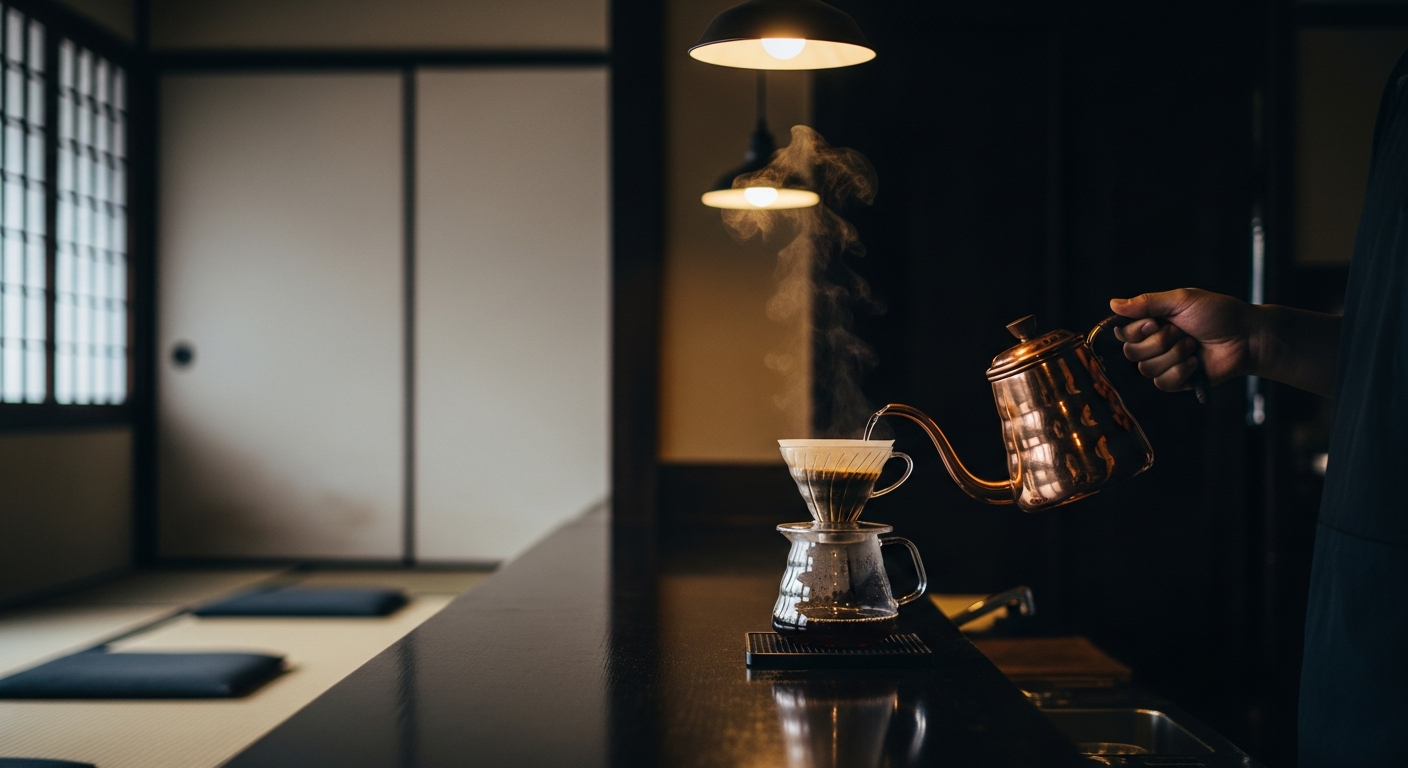
A coffee in Tokyo can take eight minutes to prepare. The barista weighs the beans, grinds them with a hand mill, blooms the slurry for forty-five seconds, then pours water in a slow concentric spiral that's been practiced for years. You wait. You don't ask why. The coffee arrives. It tastes like the careful version of every coffee you've ever had.
Japan's specialty coffee scene didn't replace its kissaten tradition. It grew from it. Kissaten, the post-war Showa-era jazz cafés that took root in the 1960s and 70s, treated coffee as a slow, contemplative ritual long before Portland or Melbourne thought to. Smoke-stained walls. Vinyl. A single coffee, served with a small cookie, lasting an afternoon. The third wave arrived in Japan with a foundation already in place.
Tokyo
Tokyo's specialty scene operates at three registers simultaneously. At the top: Glitch Coffee, where the menu changes weekly and the lightest of light roasts arrive at temperatures that respect the bean. At the heritage register: Café de l'Ambre, in operation since 1948, where the beans are aged before brewing and the espresso is built differently. At the contemporary precision register: Onibus Coffee, with its multiple Tokyo locations and a quiet international following.
Then there are the kissaten that still exist throughout the city. Lion in Shibuya. Kayaba Coffee in Yanaka. Hatou in Shibuya. These are not specialty in the contemporary sense. They are something older and arguably more important. Explore all coffee shops in Tokyo.
Kyoto
% Arabica's flagship in Higashiyama is the photogenic one, and the coffee actually justifies the line. Weekenders Coffee, hidden in a converted parking lot near Karasuma, makes the case that the best coffee in Kyoto is in unmarked spaces. Kurasu runs both a roastery and an exporter program that's brought Japanese specialty coffee equipment to baristas worldwide. Explore all coffee shops in Kyoto.
Osaka
Mel Coffee Roasters in Nishinari does single origin work with a bartender's attention. Lilo Coffee Roasters operates near Amerikamura with a roastery feel that's become the city's de facto third wave anchor. Explore all coffee shops in Osaka.
The history of Japanese coffee
Coffee arrived in Japan through Dutch traders in Nagasaki in the seventeenth century. For most of the Edo period, the bean was a curiosity rather than a beverage. Coffee culture began in earnest in the Meiji era, when Café Paulista opened in Tokyo in 1911 and introduced commercial coffeehouses to a country that had not previously had them. The first wave was Western-influenced and aspirational: coffee as a sign of modernity, served in rooms that imitated European cafés.
The kissaten era began in the post-war Showa period, primarily during the 1960s and 70s. The institution was distinctly Japanese: small rooms, dim lighting, careful single cup brewing, vinyl records, and a culture of long contemplative stays. Café de l’Ambre, opened by Ichiro Sekiguchi in 1948 in Ginza, pioneered aged coffee preparation, sometimes serving beans aged twenty years or more. Hatou in Shibuya developed siphon brewing as a refined craft. Lion in Shibuya, opened in 1926, became the canonical jazz kissaten, with enormous speakers playing classical and jazz vinyl in a room that has not been redecorated for forty years.
The third wave arrived in Japan in the late 2000s, but it built on the kissaten foundation rather than displacing it. Glitch Coffee opened in Jimbocho in 2015 and became one of Tokyo’s most respected light roast roasters. Onibus Coffee, founded in 2012, runs multiple Tokyo locations. The Hario V60 dripper, designed by the Japanese glassware company Hario in 2004, became the global third wave standard pour over device. The Kalita Wave, designed by Kalita in 1958 and rediscovered by the third wave in the 2000s, is the second most-used pour over device worldwide. Most modern specialty coffee technique has Japanese fingerprints on it.
Japanese coffee terminology
Kohi is Japanese for coffee. Hot kohi is the default. Aisu kohi is iced coffee, available year-round but particularly common during summer. Burendo (blend) refers to a multi-origin blend, the standard kissaten preparation. Sutoreto (straight) refers to single origin coffee, a kissaten term that predates the third wave use of the same concept. Burakku is black coffee. Kafe-ore is the Japanese term for café au lait, espresso or filter coffee with steamed milk.
Hando dorippu, hand drip, refers to manual pour over brewing. The Hario V60 and Kalita Wave are the most common drippers. Saifon, the siphon brewer, is a vacuum-extraction device popular at older kissaten and at Hatou in Shibuya. Nerudoripu, nel drip, is brewing through a flannel cloth filter, a labor-intensive method preserved at Café de l’Ambre and a small number of older kissaten. Aisu kohi at a serious kissaten is brewed hot then chilled quickly to preserve the cup’s clarity, a technique that the third wave subsequently adopted as Japanese iced coffee.
How Japanese coffee compares to other traditions
Japan is the only country where the kissaten tradition predated the global third wave specialty movement and continues to operate alongside it at high quality. Italy preserved its espresso tradition without developing a strong specialty wave. The United States built specialty without a strong heritage tradition to integrate with. Japan did both: preserved the kissaten and developed contemporary specialty, with both registers held at international quality.
Compared to Tokyo, the Australian and Northern European specialty traditions feel faster. The Melbourne flat white is poured in two minutes. The Tokyo pour over takes eight. The pace difference reflects different cultural commitments. Tokyo treats waiting as part of the experience. Melbourne treats efficiency as part of the craft. Both are valid. They produce fundamentally different coffees and fundamentally different café experiences.
Visiting Japan for coffee
A serious Japanese coffee trip should include both kissaten and contemporary specialty cafés. In Tokyo, plan for Café de l’Ambre in Ginza, Lion in Shibuya, and Hatou in Shibuya for the kissaten register. Add Glitch Coffee in Jimbocho, Onibus Coffee in Naka-Meguro, and Streamer Coffee Company in Shibuya for the contemporary specialty register. The two registers can be visited within a single day in central Tokyo.
For a broader Japanese coffee tour, plan a Tokyo-to-Kyoto-to-Osaka corridor. Kyoto holds % Arabica in Higashiyama, Weekenders Coffee, and Kurasu. Osaka holds Mel Coffee Roasters and Lilo Coffee Roasters. Yanaka in old downtown Tokyo holds Kayaba Coffee in its 1916 wooden building. The total Japanese coffee landscape rewards a slower travel pace, with one or two cafés per day and time built in to actually sit through the brewing process. Rushing through Japanese specialty cafés removes the point.
Japan coffee FAQ
What is a kissaten?
A kissaten is a traditional Japanese coffee shop established in the post-war Showa era, primarily during the 1960s and 70s. Kissaten typically feature careful single cup brewing, dim lighting, vinyl records, and a contemplative pace. Many are family-run and have been operating in the same location for forty to seventy years. They shaped the global third wave specialty movement before the term existed.
Why is Japanese coffee preparation so slow?
Japanese specialty coffee preparation prioritizes precision. Hand-grinding, careful blooming, and slow concentric pours produce a more controlled extraction than fast batch brewing. The pace is also cultural: waiting is treated as part of the experience, not a delay before it. The Hario V60 and Kalita Wave, both Japanese-designed pour over devices, are now the global standard for third wave specialty cafés worldwide.
What is the difference between a kissaten and a specialty café?
Kissaten are heritage spaces from mid-twentieth century Japan, often serving siphon coffee, hand drip, and aged beans, alongside cigarettes and a quiet contemplative atmosphere. Specialty cafés focus on lighter roasts, single origin sourcing, and modern brewing equipment. Both registers exist in Tokyo simultaneously, often within a five-minute walk of each other. The kissaten taught the third wave its patience. The third wave brought modern sourcing to the same conversation.
Where does Japanese specialty coffee come from?
Japan does not grow coffee at scale; the climate of the main islands is unsuitable. Japanese specialty roasters source from Ethiopia, Kenya, Colombia, Guatemala, Costa Rica, and other major producing countries, often with direct producer relationships. Some Japanese roasters source from Japanese producers in Okinawa and Ogasawara, where small-scale Arabica cultivation exists, but the volume is too low for widespread commercial use.
Is Japanese coffee culture quiet?
Yes. Most Japanese cafés, especially kissaten and contemporary specialty cafés, operate at a conversation volume below what a Western coffee shop would consider normal. Phone calls are universally avoided. The expectation of quiet is a cultural baseline that customers and staff both maintain without discussion. The result is a brewing experience in which you can hear water hitting the filter, beans being ground, and the small mechanical sounds of an espresso machine, the way you cannot in a Brooklyn or London café.
Notable Japanese coffee equipment makers
Japanese coffee equipment manufacturers shape global third wave practice. Hario, founded in 1921 in Tokyo as a heat-resistant glassware maker, designed the V60 dripper in 2004 and the Hario Switch in 2019. The V60 is now the most widely used pour over device in third wave specialty cafés worldwide. Kalita, founded in 1958, designed the Kalita Wave dripper, the second most-used pour over device. Kinto, the design-focused homewares company, makes pour over equipment that has become a global aesthetic standard. Kissaten Living, the Japanese siphon brewer manufacturer, supplies most of the high end siphon equipment used in Tokyo’s heritage cafés. The export of Japanese coffee equipment is one of the country’s most significant contributions to global third wave practice, often unacknowledged outside professional barista circles.
Earning with Pulled Coffee in Japan
Japan rewards Pulled Coffee users in two distinct registers. Tokyo, with over five thousand qualifying coffee shops in the Pulled directory, supports rapid challenge completion at any subscription tier. A traveler spending a week in Tokyo can complete the First 15 challenge in three days, contribute meaningfully to Daily 50, and visit fifteen to twenty unique specialty shops, depending on the pace they choose. The kissaten-to-specialty corridor through Shibuya, Daikanyama, and Ginza is one of the densest specialty walks in the world.
Outside Tokyo, the Japanese specialty coffee landscape is more dispersed but still productive. Kyoto holds % Arabica, Weekenders, and Kurasu within a forty-minute walking radius. Osaka adds Mel Coffee Roasters and Lilo. Tokyo to Kyoto by Shinkansen is two hours and ten minutes; the corridor produces a coffee tour that holds up against any in the world.
The pace consideration matters in Japan more than elsewhere. A serious Tokyo coffee day at the kissaten register cannot be rushed. A pour over at Glitch Coffee or a siphon at Hatou requires sitting through the brewing. Three to five careful café visits per day is the natural maximum. Pulled Coffee challenges are designed to accommodate either pace: completionists who target many shops will earn more from exploration challenges, while contemplative drinkers will accumulate streaks and tier rewards at a slower but still meaningful rate.
What Japan understands about coffee is that the experience of waiting is part of the experience of drinking. The eight minutes are not a tax on the coffee. They are the coffee. See also: Best coffee cities in Japan, what is a pour over, best coffee shops in Tokyo.
Explore coffee in Japan