March 19, 2026
Where to Get Great Coffee in Tokyo (22 Local Picks 2026)
Get paid for the gear you already use to brew.


The first Japanese coffeehouse, Kahiichakan, opened in Ueno in 1888. The proprietor, Tei Eikei, had returned from time abroad with a Western model in mind: round tables, billiards in the back room, magazines for customers, and coffee served in porcelain cups. The business closed within five years. The format took. By the 1920s, Tokyo had over a thousand cafes, including the first generation of kissaten, the seated coffee-house tradition that became Japan’s most distinctive contribution to global café culture.
Cafe Paulista, opened in Ginza in 1911 by Ryo Mizuno, was one of the early survivors. Café de l’Ambre, opened in Ginza in 1948 by Ichiro Sekiguchi, who roasted his own beans well into his 100s, became the city’s most-cited single origin specialty bar decades before the international specialty wave existed. The contemporary specialty wave grew on top of this foundation in the 2000s and 2010s, anchored by Bear Pond espresso in Shimokitazawa, Onibus Coffee in Nakameguro, Streamer Coffee Company in Shibuya, Glitch Coffee in Jimbocho, and Koffee Mameya in Omotesando. The result is a city in which the third wave and the kissaten coexist, often within walking distance, with no obvious displacement of either.
Ginza
Ginza holds Tokyo’s classical coffee register. Cafe Paulista, opened in 1911 on Chuo-dori, is the city’s oldest surviving kissaten. Café de l’Ambre on Namiki-dori roasts beans aged for five to thirty years and pours single cup brewed coffee with a precision that has shaped Japanese specialty practice for three generations. Tricolore Honten is a heritage kissaten with mid century interiors and seated table service. The Ginza cafés operate at a slower pace than the rest of central Tokyo, with most patrons sitting for forty minutes to an hour. The streets surrounding the Wako department store hold the densest concentration of historic Tokyo cafés.
Shibuya, Aoyama, and Omotesando
Streamer Coffee Company, founded by Hiroshi Sawada, the Japanese World Latte Art Champion, opened on Cat Street in 2010 and helped define Tokyo’s contemporary specialty espresso register. Sawada trained in Australia, and Streamer’s flat white program is the most Australian-influenced in central Tokyo. Blue Bottle’s Aoyama flagship, opened in 2015 in a space designed by Schemata Architects, was the brand’s second international location and remains its Japan reference. Koffee Mameya, opened by Eiichi Kunitomo in 2017 in a quiet Omotesando back-street shop, operates as a coffee tasting bar with no chairs, single origin pour overs, and the kind of focused service that has shaped Japanese specialty café format conventions worldwide. Bear Pond Espresso, the original Shimokitazawa location founded by Katsuyuki Tanaka, also has an Aoyama outpost.
Pulled pays cash for cafe visits while you weigh the gear.
Daikanyama and Nakameguro
Daikanyama is where Tokyo’s design consciousness and coffee quality converge most completely. The T-Site complex on Kyu-Yamate-dori, designed by Klein Dytham architecture, anchors the neighborhood. Onibus Coffee’s Nakameguro flagship, opened by Akito Sakata in 2011, pours pour over single origin coffee in a small two-story renovated wooden house overlooking the cherry-tree-lined canal. The shop is photographed more than almost any other Tokyo café and remains genuinely good. Sidewalk Stand, About Life Coffee Brewers, and Lattest are within a ten-minute walk. The neighborhood’s slower pace, residential character, and cherry-blossom-season foot traffic make it Tokyo’s most international-traveler-friendly specialty district.
Shimokitazawa and Setagaya
Shimokitazawa is where Tokyo’s independent culture lives. Bear Pond Espresso, founded by Katsuyuki Tanaka, was the neighborhood’s most-cited specialty café for over a decade and trained much of the contemporary Tokyo barista corps. Cafe Yuasa pours quietly in a small back-street shop. The narrow streets, the secondhand record shops, the small theater scene, and the nightlife shape a neighborhood character that the coffee culture grew into rather than imposed on. Setagaya’s broader residential character, with quieter side streets, holds smaller specialty shops at lower density than the central neighborhoods.
Yanaka, Nezu, and the shitamachi
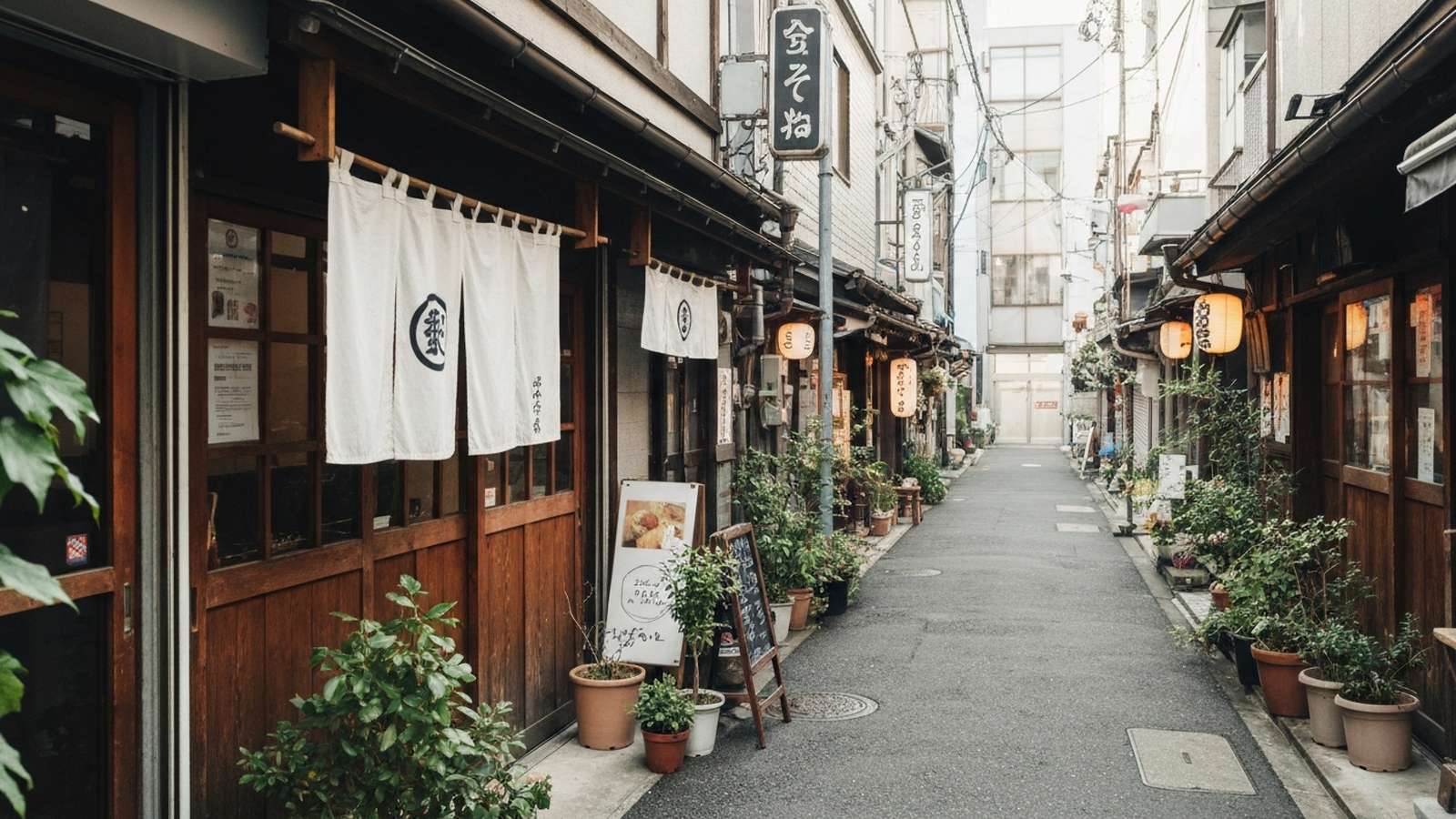
The shitamachi, the older eastern neighborhoods that survived the worst of the Tokyo air raids, hold a different Tokyo coffee experience. Kayaba Coffee, opened in 1938 in a 1916 wooden townhouse in Yanaka, is a heritage kissaten that operates within the architectural register of pre-war Tokyo. The narrow Yanaka Ginza shotengai holds several smaller kissaten and newer specialty shops. Nezu, just south, runs at similar pace. The shitamachi cafés operate at slower turnover and longer customer dwell time than central Tokyo, and the streets that surround them are some of the few in the city where pre-war wooden architecture remains visible at scale.
Jimbocho and Kanda
Glitch Coffee & Roasters, founded by Kiyokazu Suzuki in 2015 in Jimbocho, is one of Tokyo’s most internationally cited specialty roasters. The Jimbocho location pours light roast single origin filter coffee with an emphasis on transparency. The neighborhood, anchored by the dense secondhand bookshop district, has a long café tradition built around the publishing and academic populations. Cafe Hi-Lite and Cafe Cinquain are heritage kissaten in the area. The district holds one of the city’s densest concentrations of long-running cafés alongside the contemporary specialty wave.
The history of Tokyo coffee
Coffee arrived in Japan through Nagasaki in the seventeenth century via Dutch traders at Dejima. Consumption remained limited to a small commercial class through the Edo period. The drink became more widely available after the Meiji Restoration of 1868, and the first Japanese coffeehouses appeared in Tokyo in the 1880s. The kissaten format crystallized in the early twentieth century, drawing from Western café models adapted to Japanese hospitality conventions. By the 1920s, Tokyo had over a thousand kissaten, including the early establishments that survive today.
The post-war recovery rebuilt Tokyo’s coffee culture quickly. The American occupation introduced both instant coffee and a renewed café-going population. Café de l’Ambre opened in 1948. Doutor, the Japanese chain, opened its first store in 1980. UCC Ueshima Coffee, founded in 1933, became the country’s largest commercial roaster. The third wave specialty period began in the late 2000s. Bear Pond Espresso opened in 2009. Streamer Coffee Company in 2010. Onibus Coffee in 2011. Sarutahiko Coffee in 2011. Fuglen Tokyo, the Norwegian import, in 2012. Koffee Mameya in 2017. By 2018, Tokyo had achieved the highest specialty café count of any city in Asia and one of the highest globally.
How Tokyo coffee differs from other cities
Tokyo’s coffee culture differs from European or American specialty in three structural ways. First, the kissaten tradition is older and remains active alongside the third wave at meaningful density. Second, the Japanese hospitality conventions, particularly the omotenashi register at heritage kissaten, produce a different barista-customer relationship than the international specialty default. The cup is delivered with deliberate ceremony, often after eight to ten minutes of single cup pour over preparation. Third, Japanese pour over equipment, particularly Hario’s V60 dripper introduced in 2004 and Kalita’s wave dripper, has shaped global specialty filter brewing since the late 2000s.
14 day free trial. Real PayPal cash on every coffee run.
Compared to Melbourne, Tokyo is slower, more ceremonial, and more architecture-conscious. Compared to Berlin, Tokyo is quieter and more deeply integrated with traditional craft hospitality. Compared to Brooklyn, Tokyo is more precise and more individuated per cup. The Japanese specialty wave has been one of the most important global influences on contemporary specialty filter coffee, with Hario equipment, Tetsu Kasuya’s 4:6 brewing method, and the broader Japanese pour over aesthetic now standard at specialty cafés worldwide.
Best coffee shops in Tokyo
Café de l’Ambre in Ginza pours aged single origin coffee from beans roasted decades earlier, served in a 1948 interior with seated table service. Cafe Paulista in Ginza is the oldest surviving kissaten in Japan, opened in 1911. Onibus Coffee Nakameguro pours single origin pour over in a small two-story renovated wooden house. Glitch Coffee & Roasters Jimbocho roasts and pours light roast single origin filter. Koffee Mameya Omotesando operates as a tasting bar with no chairs and single cup pour overs. Streamer Coffee Company Shibuya runs Australian-influenced flat whites. Bear Pond Espresso Shimokitazawa pours competition-grade espresso. Fuglen Tokyo in Tomigaya is the Tokyo branch of Oslo’s Fuglen and pours Norwegian-roasted single origin coffee in a mid century interior. Sarutahiko Coffee Ebisu runs a serious specialty program with multiple Tokyo locations. Kayaba Coffee Yanaka operates in a 1916 wooden townhouse with a 1938 kissaten interior. About Life Coffee Brewers Shibuya is a small specialty stand near Shibuya station. Maruyama Coffee Nishiazabu pours Japanese-roasted single origin specialty.
Tokyo coffee FAQ
What is a kissaten and how is it different from a specialty café?
A kissaten is the traditional Japanese coffeehouse, characterized by seated table service, mid century interiors, dark-roasted hand-dripped coffee, and a cultural register that prioritizes long sittings and quiet conversation. The kissaten format crystallized in the early twentieth century and remains active in Tokyo at meaningful density. A specialty café operates in the international third wave register: light roast single origin coffee, transparent sourcing, espresso-machine drinks alongside pour over filter, and a barista-led service model. The two registers coexist in Tokyo and many cafés blend the formats.
What is the best Tokyo neighborhood for coffee?
Daikanyama and Nakameguro hold the densest concentration of internationally renowned specialty cafés, anchored by Onibus Coffee. Ginza holds the densest concentration of historic kissaten, anchored by Café de l’Ambre and Cafe Paulista. Omotesando holds the design-forward specialty register, anchored by Koffee Mameya and Blue Bottle. Shimokitazawa holds the independent specialty culture. Each neighborhood operates at a different register and a Tokyo coffee tour benefits from including all four.
What is omotenashi and how does it shape Tokyo coffee?
Omotenashi is the Japanese hospitality register that prioritizes anticipating guest needs without being asked. In Tokyo cafés, the convention shapes the barista-customer relationship: deliberate preparation, seated service, careful presentation of the cup, and the broader ceremonial register that surrounds even casual coffee service. Heritage kissaten operate at the highest omotenashi register. Specialty cafés operate at adapted versions of the same register. The convention is one of the central reasons Tokyo coffee feels different from European or American specialty.
Should I visit chain cafés like Doutor or Starbucks in Tokyo?
The major chain cafés operate at high consistency in Tokyo and are part of the broader Japanese coffee infrastructure. Doutor, founded in Tokyo in 1980, is one of the oldest Japanese chain cafés and pours acceptable espresso at low prices throughout the city. Starbucks Japan operates at higher quality than the global average, particularly the Reserve Roastery in Nakameguro, which is the world’s largest Starbucks Reserve location and pours single origin coffee at specialty quality. The chains are not the reason to visit Tokyo for coffee, but they are not avoided either.
What is the best season for a Tokyo coffee trip?
Late March through early April for cherry blossom season produces the most photographed café environment, particularly the Onibus Coffee canal in Nakameguro. October and November produce comfortable walking weather and lower humidity. The summer months, July through September, are humid and warm. The winter months are dry and cold but produce the cleanest air for outdoor café walking.
Earning with Pulled Coffee in Tokyo
Tokyo holds approximately five thousand qualifying coffee shops in the Pulled Coffee directory, including specialty cafés, heritage kissaten, chain locations, and neighborhood independents. The First 15 challenge ($10) is achievable in a single Tokyo day at normal café-going pace. The Daily 50 challenge ($150 to $350 at Devoted or Origin tiers) is achievable within two weeks of consistent café visits. The Pulled 50 challenge (fifty unique specialty shops, $250 to $1,500 depending on tier) is achievable in a long Tokyo stay or in a focused two-week coffee tourism trip.
A walking corridor through Daikanyama, Nakameguro, and Ebisu produces five to seven qualifying check-ins in a single morning. The Ginza-Marunouchi-Yurakucho corridor produces a comparable count over an afternoon. Shimokitazawa and Setagaya produce a quieter, more independent register. The Tokyo subway and JR network connects all major coffee neighborhoods at fifteen-minute frequency. The price register at a specialty café typically runs five hundred to seven hundred yen for a hand-dripped single origin pour over and four hundred to six hundred yen for an espresso drink. The Pulled Coffee subscription cost is recovered within the first week of normal café visit cadence at Devoted or Origin tier.
For coffee tourism specifically, a Tokyo coffee trip benefits from including the full register: a Café de l’Ambre or Cafe Paulista visit for the heritage kissaten experience, a Koffee Mameya or Glitch Coffee visit for the contemporary specialty register, and an Onibus or Streamer visit for the third wave international flagship register. The total day produces six to eight unique check-ins toward Pulled challenges and a layered understanding of Tokyo coffee that no single category captures alone.
See the full list of shops on the Tokyo coffee guide. Related reading: Seoul, Singapore, how to order in Japan.
Start earning from your coffee habit.
Pulled Coffee pays you real money via PayPal for checking in at cafes and coffee shops.
Download Pulled CoffeeEarn cash on every coffee run. Download Pulled.
Explore coffee in Tokyo