March 9, 2026
18 Seoul Coffee Shops Worth a Detour (2026 Guide)
Get paid for the gear you already use to brew.


Coffee arrived in Korea in 1896. Emperor Gojong, having fled the Japanese-occupied royal palace, took refuge at the Russian legation in Seoul and was reportedly served coffee daily during his year of asylum. The drink became fashionable at the late-Joseon court and spread to the broader Korean population through the early twentieth century, primarily as instant coffee and primarily during the Japanese colonial period (1910-1945) and the post-war American military presence. By the 1970s, Maxim Coffee Mix, the Dongsuh Foods instant coffee packet that combined coffee, creamer, and sugar in a single tear-open sachet, had become the country’s default coffee format and remained dominant for nearly four decades.
The contemporary specialty wave began around 2008-2010 with Anthracite Coffee, Coffee Libre, and Terarosa. Starbucks Korea, opened in Ewha Womans University in 1999, helped establish the seated café register. The Korean café boom that followed produced one of the highest café-per-capita densities in the world. Seoul alone now holds over twenty thousand cafés, including specialty roasters, design-forward concept cafés, study-focused study cafés, and the broader chain register. The density and the speed at which new cafés open and old ones reinvent themselves create an environment that is unlike any other coffee city in the world.
Yeonnam-dong and Hongdae
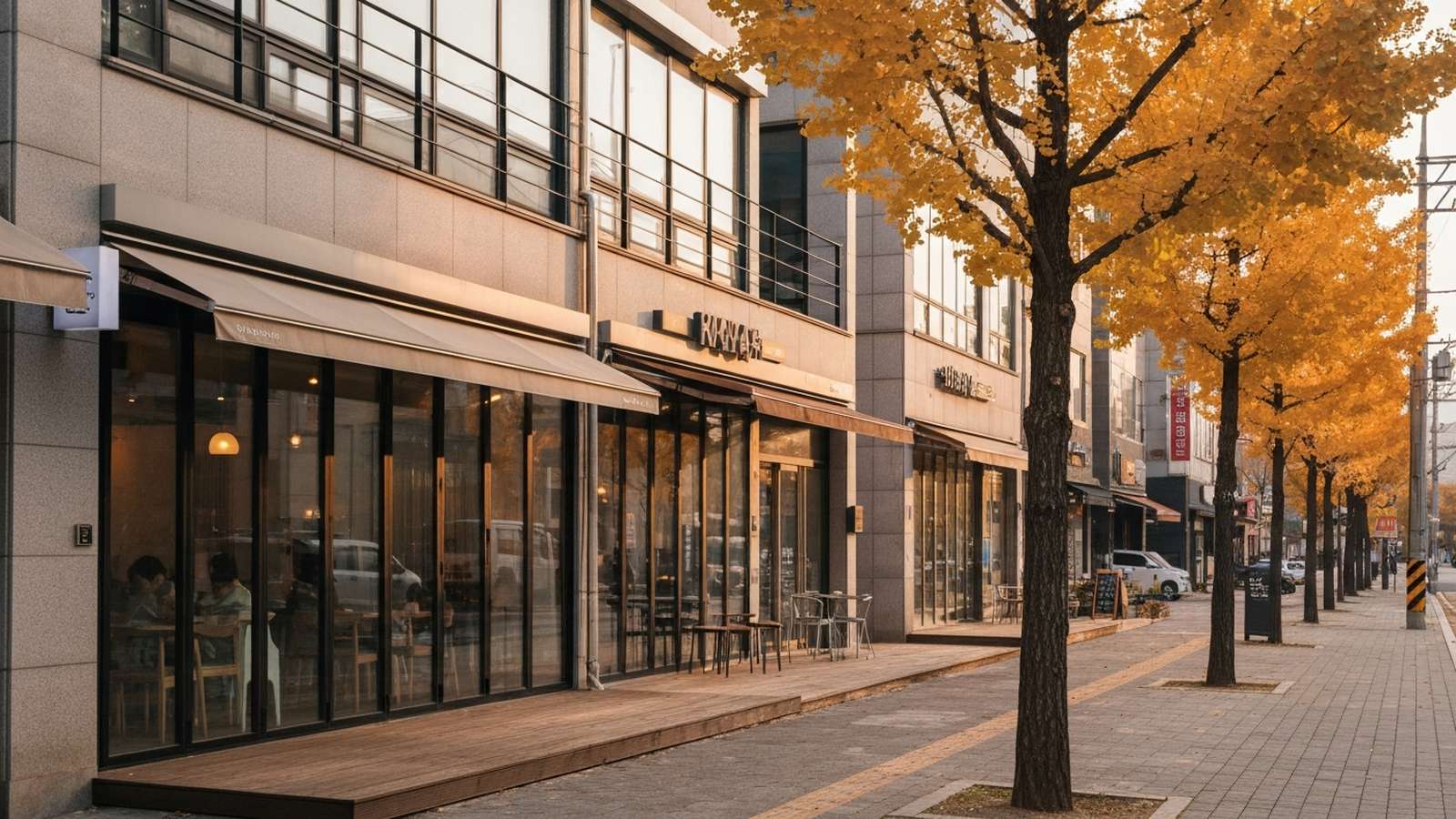
Yeonnam-dong, just north of Hongik University’s Hongdae area, became the center of Seoul’s contemporary café culture in the early 2010s. The neighborhood’s narrow streets, residential architecture, and proximity to the university produced a café register oriented toward younger Koreans who take coffee, design, and atmosphere equally seriously. Manufact Coffee Roasters, founded in 2014, runs both a roastery and multiple Yeonnam-dong cafés. Coffee Libre’s Yeonnam location remains essential. The Saturday and Sunday morning café walks in Yeonnam-dong are one of the best coffee experiences in Asia. Hongdae’s adjacent university-driven café culture extends the network southward.
Seongsu-dong
Seongsu-dong, often described as Seoul’s Brooklyn, has attracted the most design-forward cafés in the city. The neighborhood’s industrial heritage, particularly the former shoe-factory district between Seongsu Station and the Han River, has been converted into café and concept-store spaces over the past decade. Fritz Coffee Company, founded in 2014 by Park Geun-ha and four partners, runs the flagship Seongsu roastery and is one of Korea’s most internationally cited specialty operations. Daelim Changgo on the eastern Seongsu side combines a former warehouse with a multi-story café-restaurant program. Onion Anguk and Onion Seongsu hold concept-café flagships. Seongsu’s café density now exceeds most central Seoul districts.
Pulled pays cash for cafe visits while you weigh the gear.
Itaewon and Hannam-dong
Itaewon’s international character has shaped a café culture that draws from multiple global traditions simultaneously. The neighborhood was historically the home of Seoul’s international residents and US military personnel, which produced an early absorption of Western café culture in the broader Seoul context. Anthracite Coffee, founded in 2009, runs the Hannam-dong flagship in a converted shoe-factory building. The café is one of the city’s most-cited specialty references. The steep hills and narrow streets provide an urban environment unlike any other Seoul neighborhood. Hannam-dong’s newer residential and commercial development has produced a quieter specialty register adjacent to Itaewon’s busier main strip.
Bukchon and Insadong
Bukchon Hanok Village, the surviving traditional Korean architecture quarter between Gyeongbokgung and Changdeokgung palaces, has attracted cafés that operate within or adjacent to Korea’s architectural heritage. The tension between traditional neighborhood character and contemporary café culture is handled with more grace here than in most of Seoul’s gentrifying areas. Several cafés operate in renovated hanok with traditional ondol heating, paper sliding doors, and inner courtyard gardens. Insadong’s art gallery and craft shop concentration, just south of Bukchon, creates a morning environment for coffee that rewards walking. The proximity to Gyeongbokgung, Changdeokgung, and the broader Jongno historic district makes the Bukchon-Insadong corridor one of the most layered café walks in the city.
Apgujeong and Cheongdam
Seoul’s Gangnam luxury fashion district has attracted cafés that match its aesthetic ambitions. The relationship between Korea’s fashion and beauty industry and its café culture is unusual: cafés here function partly as showrooms, partly as social spaces, and partly as genuine coffee destinations. Dior Cafe and Gucci Osteria’s café space have made the neighborhood a reference point for design-forward concept coffee. Maison Kitsuné, Anteroom, and the broader Gangnam concept-café network operate at high design intensity. The price register here runs significantly higher than the rest of Seoul, with specialty drinks often priced at fifteen thousand won or above. The neighborhood’s café culture is not the most coffee-focused in Seoul but is the most internationally recognized.
Hapjeong, Mangwon, and Yeonhui-dong
Hapjeong’s position between Hongdae and the Han River has made it one of Seoul’s most dynamic neighborhoods for cafés over the past decade. The Sunday morning market at Mangwon creates a weekly rhythm that draws coffee-conscious residents from across the city. Both Hapjeong and Mangwon operate at a slightly lower commercial intensity than Hongdae or Yeonnam-dong, which makes them more comfortable for long sittings. Yeonhui-dong, a quieter residential district just west of Yeonnam-dong, holds smaller specialty operations including the Coffee Libre roastery and several lesser-known reference cafés. The corridor from Hapjeong to Mangwon to Yeonnam-dong to Yeonhui-dong is one of the densest specialty walks in Seoul.
The history of Seoul coffee
Coffee arrived in Korea through the Russian legation in 1896 during Emperor Gojong’s year of asylum. The drink became fashionable at the late-Joseon court and spread through the Korean population during the colonial period (1910-1945). The post-war American military presence introduced instant coffee at scale; by the 1960s, instant coffee had become the country’s default home format. Maxim Coffee Mix, introduced by Dongsuh Foods in 1976, combined coffee, creamer, and sugar in a single packet and became the canonical Korean coffee for nearly four decades.
The seated café register expanded after the 1988 Seoul Olympics, with the country’s broader internationalization producing demand for Western-style café service. Doutor opened in 1989. Starbucks Korea opened its first store at Ewha Womans University in July 1999. The local chain Hollys Coffee opened in 1998. The Korean café boom of the 2000s produced an extraordinary expansion of seated café service, with the broader study café register becoming structurally integrated with Korean university and white-collar life.
The specialty wave began around 2008-2010. Coffee Libre, founded in 2009 by Seo Pil-hoon, was Korea’s first internationally cited specialty roaster. Anthracite Coffee opened in Itaewon in 2009. Terarosa expanded its Gangneung roastery operations into Seoul during the same period. Fritz Coffee Company opened in 2014. By 2018, Seoul had achieved international specialty status, and the city now hosts one of the highest specialty café counts of any Asian capital.
14 day free trial. Real PayPal cash on every coffee run.
How Seoul coffee differs from Tokyo and Singapore
Seoul’s coffee culture differs from Tokyo’s in two structural ways. First, the kissaten heritage tradition that anchors Tokyo coffee has no Korean equivalent; Seoul’s café culture is younger and more contemporary-design-driven. Second, the Korean café functions more explicitly as a social space, a study space, and a concept-driven destination than the Tokyo café. The combination produces a café register that is more visually dramatic than Tokyo’s and operates at higher commercial intensity per location.
Compared to Singapore, Seoul runs at higher café density, lower per-cup pricing, and stronger emphasis on the concept-café format. Compared to Hong Kong, Seoul is more dispersed across multiple neighborhoods rather than concentrated in central districts. Compared to Bangkok, Seoul’s café register is more design-forward and runs at higher per-shop investment. The Korean concept-café boom has been one of the most influential global café format developments of the past decade, with Korean-style design, Korean-influenced drink menus (the sweet-potato latte, the injeolmi coffee, the dalgona coffee), and the broader Korean café aesthetic now visible at international cafés in Tokyo, Hong Kong, Singapore, Los Angeles, and New York.
Best coffee shops in Seoul
Coffee Libre Yeonnam-dong is the original Coffee Libre roastery. Anthracite Hannam-dong runs in a former shoe factory. Fritz Coffee Company Seongsu is the Fritz flagship roastery. Manufact Coffee Roasters Yeonnam-dong runs both roastery and café. Terarosa Sinsa-dong is the Seoul flagship of the Gangneung roastery. Onion Anguk operates in a renovated hanok. Onion Seongsu runs in a former metal factory. Daelim Changgo Seongsu combines former warehouse and contemporary café. Cafe Layered Anguk runs the Korean-style scone and coffee program. Tailor Coffee Itaewon pours espresso in a small front room. Felt Coffee Itaewon runs single origin filter. Center Coffee Yeonhui-dong runs a quiet specialty operation. Coffeenatmag in Hapjeong pours single origin pour over.
Seoul coffee FAQ
Why does Seoul have so many cafés?
Seoul holds one of the highest café-per-capita densities in the world. The structural reasons include high real estate density, the broader Korean café-as-social-space culture that emerged in the 1990s, the post-IMF (1997-1998) entrepreneurial wave that produced thousands of small café businesses, and the Korean café-as-concept format that drew investment from designers, fashion brands, and cultural producers. The country also lacks the extensive pub or bar culture that occupies the same social register in Western cities, which means cafés serve a broader social function in Korean daily life.
What is dalgona coffee and where can I drink it?
Dalgona coffee is whipped instant coffee with sugar, served over cold milk, named after the Korean dalgona honeycomb candy because of its similar color and texture. The drink became globally viral in 2020 during the pandemic. Most Korean cafés now serve it on the menu, particularly during the spring and summer months. The drink is more closely associated with home preparation than with specialty cafés, but the format has been widely commercialized.
What is the best Seoul neighborhood for specialty coffee?
Yeonnam-dong holds the highest specialty café density in Seoul, anchored by Manufact and Coffee Libre. Seongsu-dong holds the most design-forward concept-café register, anchored by Fritz, Onion, and Daelim Changgo. Hannam-dong/Itaewon hold the international specialty register anchored by Anthracite. Bukchon holds the heritage hanok-café register. Each operates at a different cultural register and a Seoul coffee tour benefits from including all four.
What is a study café and is it the same as a regular café?
A study café (study cafe in Korean usage) is a Korean café format optimized for individual study sessions, typically with private booths, hourly pricing, premium wifi, and quieter environments than the standard concept café. Study cafés operate alongside the broader café register and are particularly common near universities, in study-heavy neighborhoods, and as franchise operations. They are not specialty coffee destinations but they are an important part of the broader Korean café infrastructure.
How does Korean café culture compare to Japanese?
Korean café culture is more design-forward, faster-changing, and more concept-driven than Japanese café culture. Japanese coffee operates with the older kissaten tradition and the broader omotenashi hospitality register. Korean coffee operates with the newer concept-café tradition and the broader visual-and-social register. Both produce excellent coffee at the specialty level, but the cultural surroundings of the cup are meaningfully different.
Earning with Pulled Coffee in Seoul
Seoul holds approximately fifteen thousand qualifying coffee shops in the Pulled Coffee directory, including specialty cafés, concept cafés, chain locations, and the broader study café register. The First 15 challenge ($10) is achievable in a single Seoul day at normal café-going pace. The Daily 50 challenge ($150 to $350 at Devoted or Origin tiers) is achievable in two weeks of consistent café visits. The Pulled 50 challenge (fifty unique specialty shops) is achievable in a long Seoul stay.
A walking corridor through Yeonnam-dong and Hongdae produces six to nine qualifying check-ins in a single morning. The Seongsu-dong corridor produces a comparable count. The Hannam-Itaewon walk and the Bukchon-Anguk-Insadong walk both produce four to six check-ins. The Seoul Metro connects all major café neighborhoods at three to five-minute frequency, and the broader Seoul Bus and Kakao Map navigation systems make multi-neighborhood coffee circuits practical.
The Seoul price register varies by neighborhood. A standard specialty café americano runs four thousand to five thousand five hundred won. A specialty hand-drip pour over runs six thousand to ten thousand won. Concept-café drinks at Apgujeong or Seongsu can run twelve thousand to eighteen thousand won. The Pulled Coffee subscription cost is recovered within the first few weeks of normal café visit cadence at Devoted or Origin tier. The integration is particularly favorable for Seoul residents who already build multiple daily café visits into their working rhythm.
Explore Seoul’s café map at the Seoul coffee guide. Related reading: Tokyo, Singapore.
Start earning from your coffee habit.
Pulled Coffee pays you real money via PayPal for checking in at cafes and coffee shops.
Download Pulled CoffeeEarn cash on every coffee run. Download Pulled.
Explore coffee in Seoul