May 10, 2026
How to Make Pour Over Coffee: The Complete Guide
Some links in this guide are affiliate links. If you buy through them, Pulled may earn a commission at no extra cost to you. Our recommendations are based on editorial judgment and coffee culture knowledge, not commission rates.
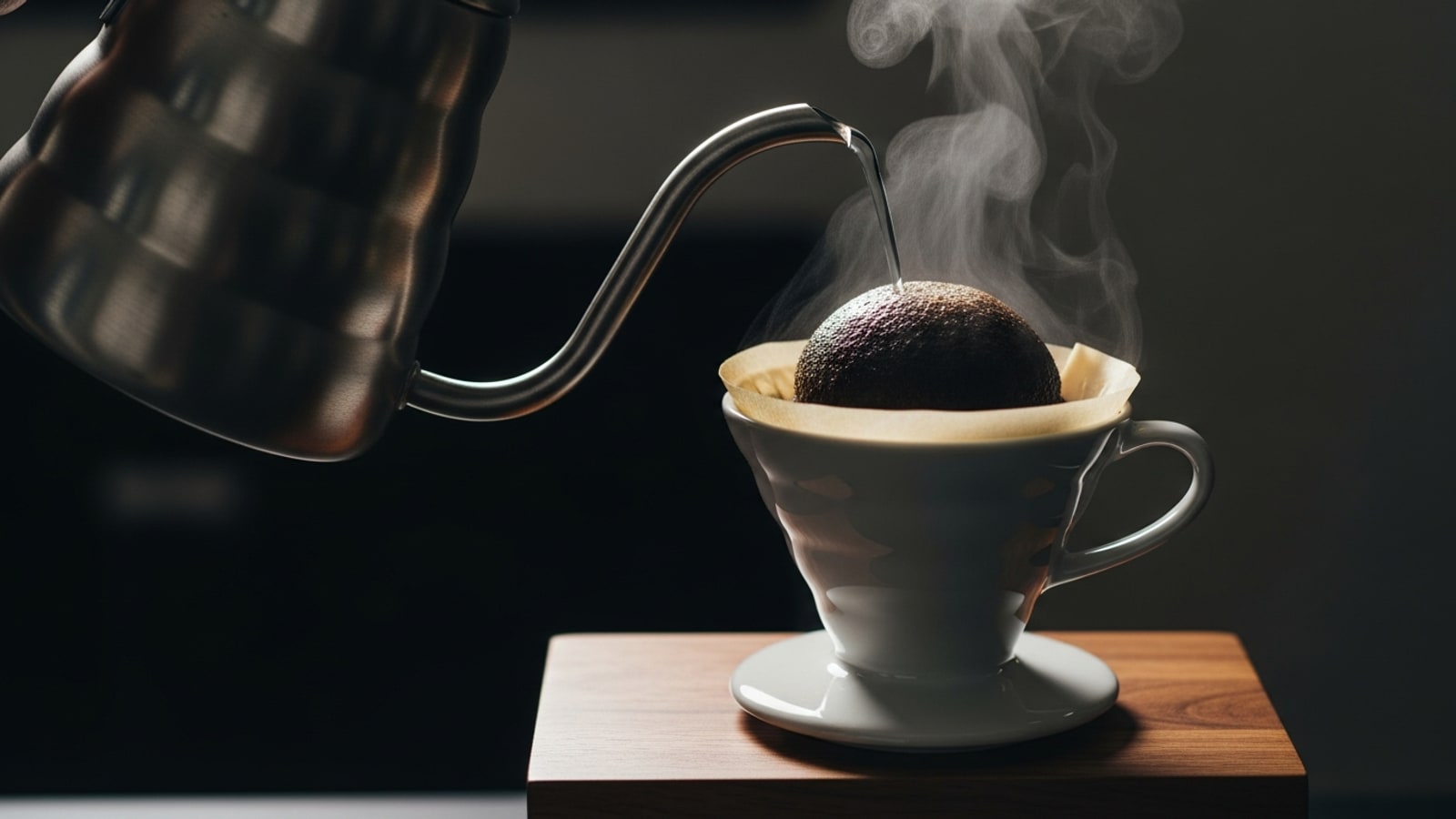
Pour over is the method that separates good home coffee from great home coffee. It takes four minutes. It uses paper, water, and gravity. It is the closest you will get at home to the cup a third wave barista pulls for you on a Tuesday morning.
It is also the method that goes wrong in the most ways. A pour over needs a real grind, a real ratio, a real bloom, and a real pour. Skip any of those and the cup tastes thin, sour, or muddy. The good news is that none of the variables are mysterious. Once you understand each one, you can dial in a clean cup in two or three tries.
What pour over actually is
Pour over is brewing coffee by pouring hot water through a bed of grounds held in a paper filter inside a cone or wave-shaped dripper. Water passes through the grounds once, picks up flavor, and drips into a vessel below. No pressure, no immersion.
The difference between pour over and a drip machine is control. A drip machine pours on its own schedule. A pour over is hand poured, which means you decide the speed, the agitation, the bloom time, and the total brew time. Every one of those choices changes the cup.
The flavor profile is cleaner than a French press and brighter than drip. Paper catches the oils and fine sediment that immersion methods leave behind. You can taste the bean. A well roasted Ethiopia tastes floral and citric. A washed Colombia tastes sweet and round. Drip flattens those notes. Pour over keeps them. To see how pour over sits next to other methods, read pour over vs espresso vs cold brew.
The three drippers that matter
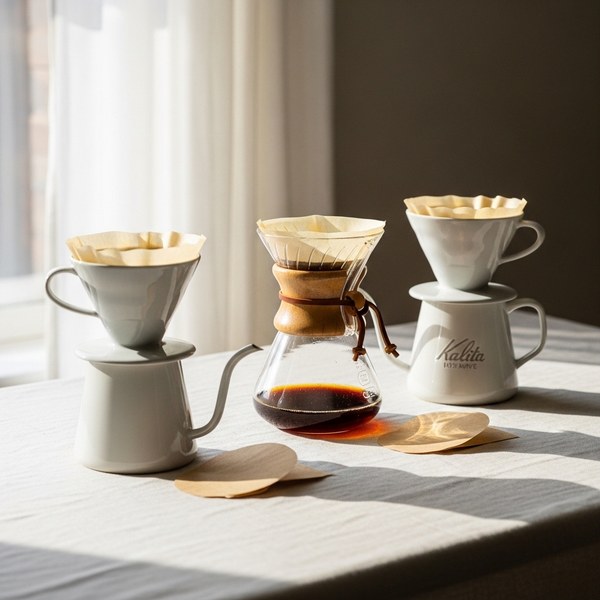
There are dozens of pour over drippers. Most are variations on three originals. Each has a different geometry, a different filter, a different flow rate, and a different cup. None of them is universally best. They make different coffee.
Hario V60
The V60 is a 60 degree cone with spiral ridges and a single large hole at the bottom. It is the dripper most third wave shops use because it is the most responsive to technique. A small change in your pour rate changes the cup. That is a feature if you want to dial in a recipe. It is a bug if you want forgiveness.
The V60 produces a clean, bright, articulated cup. The big drain hole moves water through quickly, which suits a finer grind and a faster pour. V60 filters are the thinnest of the three, which lets aromatics through. Ceramic, glass, and plastic bodies all brew the same coffee.
Chemex
The Chemex is an hourglass shaped glass carafe with a built in cone at the top. It uses its own filters, which are noticeably thicker than V60 papers. That thickness slows the drain and traps more oils, which produces a cleaner, lighter, tea like cup. Some people love that profile. Others find it too thin. A Chemex brewed with a light roast Ethiopia tastes more like jasmine tea than like coffee.
Because the filter is thick, the Chemex wants a slightly coarser grind and a longer total brew time than a V60. The carafe doubles as a serving vessel. The downsides are real. Chemex filters cost more than V60 papers and have to be folded with three layers facing the spout. The glass is fragile. A full carafe can run five minutes or longer.
Kalita Wave
The Kalita Wave is a flat bottomed dripper with three small holes at the base and a wavy paper filter that sits inside it. A flat bed extracts more evenly than a cone because the water travels the same distance through the grounds regardless of where you pour. In a V60, water at the center has more coffee to travel through than water at the edges. In a Kalita, the bed is uniform, so the brewer is more forgiving.
The three small holes slow the drain, so contact time is longer and the cup is heavier. The result is fuller and sweeter than a V60 but slightly less articulate. Many baristas call it the easiest of the three to brew well.
Which one should you buy first
If you want the most articulate cup and you are willing to dial in technique, buy a V60. If you want a clean, tea like cup and a serving vessel in one, buy a Chemex. If you want the most forgiving brewer, buy a Kalita Wave. All three cost between fifteen and forty dollars. None of them is wasted money.
The equipment list
The dripper is the centerpiece. A few other things matter.
- A burr grinder. The single most important purchase. A blade grinder produces uneven particles and uneven particles produce an uneven extraction. Hand crank burr grinders start around forty dollars.
- A gooseneck kettle. The narrow spout gives you the control to pour a slow, even stream where you want it.
- A digital scale that reads in grams. Weigh both the coffee and the water.
- A vessel below the dripper. A mug for one. A glass server for two or more. The Chemex is its own server.
- Fresh whole bean coffee, roasted within the past three weeks.
You can build the whole setup for two hundred dollars or less. If you need help finding specialty beans in your city, read how to find specialty coffee shops near you.
The coffee to water ratio
The standard pour over ratio is 1 to 16 or 1 to 17 by weight. That means 1 gram of coffee per 16 or 17 grams of water. Water at room temperature weighs essentially the same as its volume in milliliters, so 16 g of water is 16 ml.
For a single mug, 22 g coffee to 350 ml water (0.78 oz to 12 oz) is a comfortable starting point. For a small carafe (two cups), 30 g coffee to 480 ml water (1 oz to 16 oz). For a full Chemex serving three to four cups, 50 g coffee to 800 ml water (1.75 oz to 28 oz). All of those are 1 to 16.
If you want a more delicate cup, go to 1 to 17. So 30 g coffee to 510 ml water for the small carafe. If you want stronger, go to 1 to 15. So 30 g coffee to 450 ml water. Most third wave shops brew somewhere in that range. Outside it, the cup tastes either watery or harsh.
Weigh both the coffee and the water. Volume measurements for coffee are unreliable because beans vary in density. A scale removes the guesswork.
Grind size
Pour over uses a medium grind. The visual reference is kosher salt or coarse sand. Bigger than espresso (fine and powdery), smaller than French press (chunky like sea salt), roughly the same as a typical drip grind.
Each dripper wants a slightly different size inside that medium window. A V60 brews best with medium fine because the big drain hole moves water through quickly and a finer bed slows extraction back to where it belongs. A Chemex wants medium coarse because the thick filter and small spout already slow the drain. A Kalita Wave wants medium, right in the middle.
If your cup tastes sour, weak, or salty, the grind is too coarse. Tighten the grinder one or two clicks finer. If your cup tastes bitter, astringent, or dry on the tongue, the grind is too fine. Open the grinder one or two clicks coarser. Sour means coarser is wrong. Bitter means finer is wrong. Two or three adjustments and you will land on the size your grinder and your beans want.
The bloom
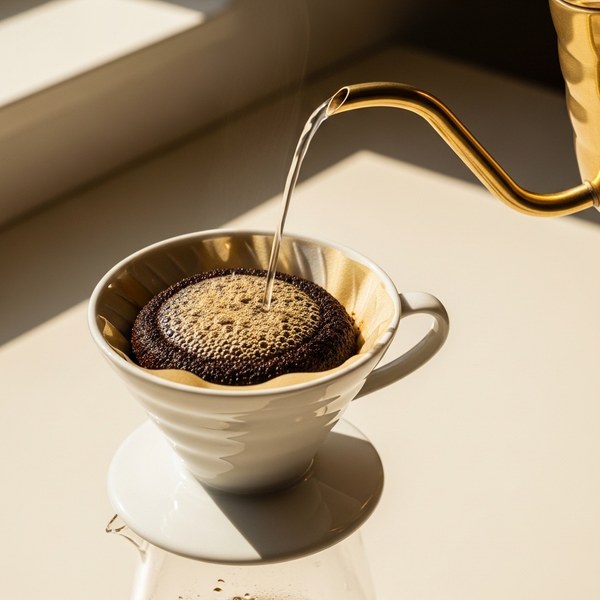
The bloom is the first pour. You wet the grounds with about twice their weight in water (60 g of water for 30 g of coffee, give or take), wait 30 to 45 seconds, then start the main pour.
What is happening is that the coffee is releasing carbon dioxide. Freshly roasted coffee is full of CO2 from roasting. When hot water hits the grounds, the gas escapes as bubbles and foam rising on the surface. If you start the main pour before the bloom has finished degassing, the CO2 fights against the water trying to seep into the grounds, and the extraction goes uneven.
How vigorous the bloom looks is a rough freshness indicator. A coffee roasted in the past week produces a thick, foamy, domed bloom. A coffee roasted three months ago barely puffs. Stale coffee blooms weakly because most of the CO2 has already escaped into the bag.
The pour should saturate every ground. If you see dry pockets, give the dripper a gentle swirl. Wait 30 to 45 seconds before the main pour. Very fresh beans can bloom for up to 60 seconds. Past 60 seconds the bed starts cooling too much.
Pour technique
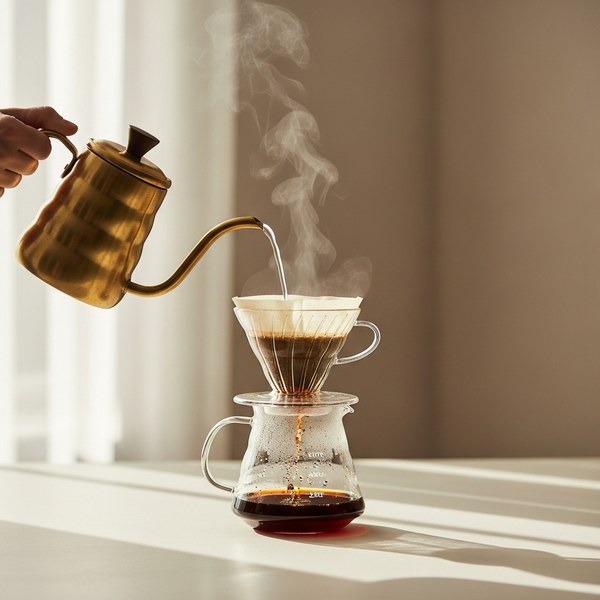
The main pour is what people argue about. There are two schools.
The pulse pour is several smaller pours separated by short pauses. You bloom, pour to about half the total water weight, wait for the bed to drain partway, then pour the rest. Two pulses is the simplest version. Three gives more control. Each pulse refreshes the water on top and re-agitates the bed, which evens out the extraction.
The continuous pour is one steady stream from the end of the bloom to the end of the brew. It produces a slightly cleaner cup because the bed stays fully submerged the whole time. It is harder to do consistently. For a beginner, the pulse pour is more forgiving.
Pour in a slow circular motion starting at the center and spiraling outward, then back inward. Do not pour on the filter walls. The paper does not need wetting, and pouring on the walls washes fines into the filter where they slow the drain. Stay over the bed, keep the stream thin (the gooseneck is built for this), and aim for the same motion every time. The stream should be the diameter of a pencil lead, kettle an inch or two above the bed.
Total brew time
Total brew time is the time from the start of the bloom pour to the last drip leaving the dripper. Target for a single mug (22 g coffee, 350 g water): 3 to 3 and a half minutes. Target for a small carafe (30 g coffee, 480 g water): 3 and a half to 4 minutes. Target for a full Chemex (50 g coffee, 800 g water): 4 and a half to 5 minutes.
If your brew finishes faster than the target, the grind is too coarse and the cup will taste weak. Tighten the grind. If your brew runs longer, the grind is too fine and the cup will taste bitter. Open the grind. Total brew time is the single number that tells you whether your grind is in the right zone.
The V60 recipe (one mug)
Step 1. Place the filter in the dripper, set on top of your mug, and rinse thoroughly with hot water. Empty the mug.
Step 2. Grind 22 g of coffee medium fine. Add to the filter. Tap to level.
Step 3. Place dripper plus mug on the scale, tare, start the timer.
Step 4. Bloom with 50 to 60 g of water in a slow spiral. Wait 30 to 45 seconds.
Step 5. At 0:45, pour in slow spirals to 200 g total. Pencil-lead stream over the bed.
Step 6. When the bed exposes around 1:45, pour to 350 g total. Done pouring by 2:30.
Step 7. Let drain. The last drip should fall at 3:00 to 3:30. Lift the dripper, discard the filter, swirl, drink.
The Chemex recipe (small carafe)
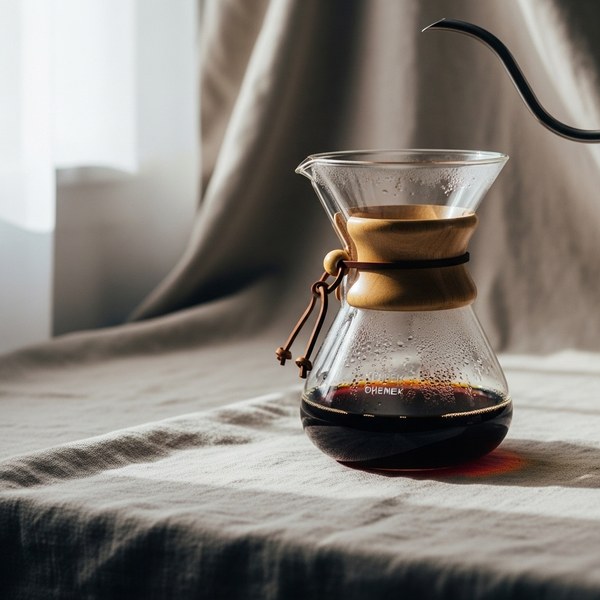
Chemex filters fold into a cone with three paper layers on one side and one on the other. The three layer side goes against the spout. This blocks the air channel and gives a cleaner drawdown.
Rinse the filter the same way as the V60. Add 30 g of medium coarse ground coffee. Tare. Bloom with 60 to 75 g, wait 45 seconds. Then pour in three pulses. Reach 220 g around 1:30. Reach 350 g around 2:30. Pour the final 130 g to land at 480 g by 3:30. Total brew time including drawdown should be 4 and a half to 5 minutes. The Chemex drains slowly because of the thick filter. Do not rush it.
The Kalita Wave recipe
The Kalita Wave brews almost identically to the V60 with two adjustments. The grind is one click coarser (medium instead of medium fine) because the three small drain holes already slow the flow. The total brew time is slightly longer (3 and a half to 4 minutes instead of 3 to 3 and a half). Otherwise the steps are the same. Rinse, add coffee, bloom, two pulses, drawdown.
The flat bed makes the Kalita more forgiving of pour technique. Even if your spiral is sloppy, the water hits the same depth of coffee at every point in the bed. This is the dripper to learn on if you find the V60 too sensitive.
Water temperature
Pour over water should be 195 to 205 degrees Fahrenheit (90 to 96 Celsius). The standard target is 200F or 93C. Above 205F and the water pulls harsh extraction. Below 195F and the cup tastes underdeveloped. Boiling water is 212F. It drops to roughly 200F in about 30 seconds in an open kettle. Light roasts want the higher end. Dark roasts want the lower end. Medium roasts split the difference. 200F is a safe default.
Common mistakes
1. Wrong grind size. Too coarse and the cup is sour and thin. Too fine and the cup is bitter and astringent. Watch the brew time and adjust.
2. Skipping the filter rinse. An un-rinsed paper filter tastes like paper. Always rinse before adding coffee.
3. Pouring on the filter walls. Washes fines into the filter where they slow the drain. Stay over the bed.
4. Pouring too fast. A fast pour floods the bed and channels through fast paths. Slow down.
5. Skipping the bloom. CO2 fights against the brew water. Always bloom for 30 to 45 seconds.
6. Wrong ratio. A 1 to 12 ratio brews a bitter sludge. A 1 to 20 ratio brews a watery tea. Stay in the 1 to 15 to 1 to 17 window.
7. Stale beans. Beans roasted more than four to six weeks ago will not bloom and will taste flat.
8. Cold equipment. A cold mug steals heat and drops the extraction temperature. Rinse with hot water.
9. Preground coffee. Coffee loses aromatics within minutes of being ground. Grind fresh.
10. Volume instead of weight. Beans vary in density. Use a scale.
Frequently asked questions
What is the best ratio for pour over coffee? 1 to 16 or 1 to 17 by weight. 22 g of coffee to 350 g of water for a mug. 30 g of coffee to 480 g of water for a small carafe.
What grind size is best for pour over? Medium, like kosher salt. V60 finer, Chemex coarser, Kalita in the middle. Sour means coarser is wrong. Bitter means finer is wrong.
How long should the bloom last? 30 to 45 seconds. Pour twice the coffee weight in water, wait for the CO2 to release, then start the main pour.
Chemex vs V60? Chemex uses thicker filters and brews a cleaner, lighter cup. V60 uses thin filters and brews a more articulate cup with more body. Both are valid choices.
How long should a pour over take? 3 to 3 and a half minutes for a mug. 3 and a half to 4 for a small carafe. 4 and a half to 5 for a full Chemex.
What temperature should the water be? 200F or 93C. Range is 195 to 205F. Boil and wait 30 seconds.
Do I need a gooseneck kettle? In practice, yes. A regular kettle pours too fast and floods the bed.
Can you make pour over without a scale? Technically yes. Practically no. A scale is ten dollars and is the cheapest upgrade that improves your cup.
The point of brewing pour over at home
A specialty pour over at a third wave cafe costs six to eight dollars. The same cup at home, brewed with the same beans, costs about a dollar in coffee and a few cents in paper. Once the equipment is paid off, you are drinking great coffee for a fraction of the cafe price. You also get to control everything: the bean, the roast level, the ratio, the grind, the bloom, the pour. The cafe version is great but it is the cafe's version. If you want the cultural background on why pour over took over, read what is third wave coffee.
If you do still want to support the cafes where you live, Pulled Coffee pays you back real cash for every check-in at any coffee shop. Drink the cafe pour over on Saturday, brew the home version Monday through Friday, and the app counts both. See how the challenges work or read how members are earning money drinking coffee in 2026.
Get Pulled.
Earn up to $10,000 exploring coffee shops. Real cash. Real shops. Real rewards.
Download PulledRelated reading: pour over vs espresso vs cold brew, how to make cold brew at home, how to make iced coffee at home, how to make a latte at home, specialty coffee vs chain coffee, the best coffee apps in 2026.
Our Picks
What we'd buy on Amazon for this
Hario · V60 Paper Filters (Size 02, 100 pack)
The Hario originals. Cheap white paper filters get a chemical taste.
$8.99
View on Amazon →Hario · V60 Size 02 Ceramic Dripper
The reference dripper.
Hario · V60 Fretta Iced Coffee Maker
The dedicated Japanese iced coffee setup.
$23.95
View on Amazon →


Pulled may earn a commission on purchases. Cookie applies to all Amazon items in your next 24 hours, not just this product.
See all Pulled Picks →Keep going with Pulled