May 10, 2026
French Press Ratio: The Complete Guide to Coffee, Water, and Time
The short answer. Use 1 gram of coffee for every 15 grams of water. For a standard 32 oz French press, that is about 60 g coffee to 900 ml water. For a small 12 oz press, that is about 20 g coffee to 300 ml water. Coarse grind. Off boil water at around 200 F (93 C). Brew for 4 minutes. Press slowly. Decant immediately so the grounds stop steeping.
That is the recipe. If you want to know why 1:15 is the canonical ratio, how to measure when you do not own a scale, and the small adjustments that quietly change everything, the rest of this guide is for you.
Why 1:15 is the canonical starting point
Every brewing method has a sweet spot ratio. Drip coffee lives around 1:17. Pour over lives around 1:16. espresso pulls at roughly 1:2. The French press sits at 1:15.
The reason is the steep. A French press is a full immersion brewer. The grounds and the water stay in contact for the entire brew, so every particle gets the same contact time. That is different from pour over, where water moves through a bed of grounds and the contact time varies based on flow rate. Full immersion is more aggressive at the same ratio, so you use slightly less coffee than a pour over to land in the same flavor window.
Brew weaker than 1:15 and the cup tastes thin. Brew stronger than 1:15 and the cup gets heavy and a little syrupy. 1:15 is the line where the body feels full but the flavor stays clean. Recipes online go anywhere from 1:12 to 1:18, tuned for specific beans or drinkers, but 1:15 is the default that works for almost every coffee.
The full ratio table
French presses are sized in ounces, which tells you how much finished coffee the press holds. Match your press size to the row below.
- 4 oz press (single small cup): 8 g coffee to 120 ml water
- 8 oz press (one full cup): 16 g coffee to 240 ml water
- 12 oz press (typical small): 20 g coffee to 300 ml water
- 16 oz press (medium): 27 g coffee to 400 ml water
- 20 oz press (medium plus): 33 g coffee to 500 ml water
- 24 oz press (large): 40 g coffee to 600 ml water
- 32 oz press (standard large): 60 g coffee to 900 ml water
French press ounces are usually the brewer's marketing number, not the actual usable volume. The grams in the table account for that and are tuned to produce roughly the labeled amount of drinkable coffee. You can also scale freely. Double everything for a bigger batch. Halve for a single cup. The chemistry does not care about absolute amounts. If your press is an odd size, find the closest two rows and interpolate. The window is forgiving.
How to measure without a scale
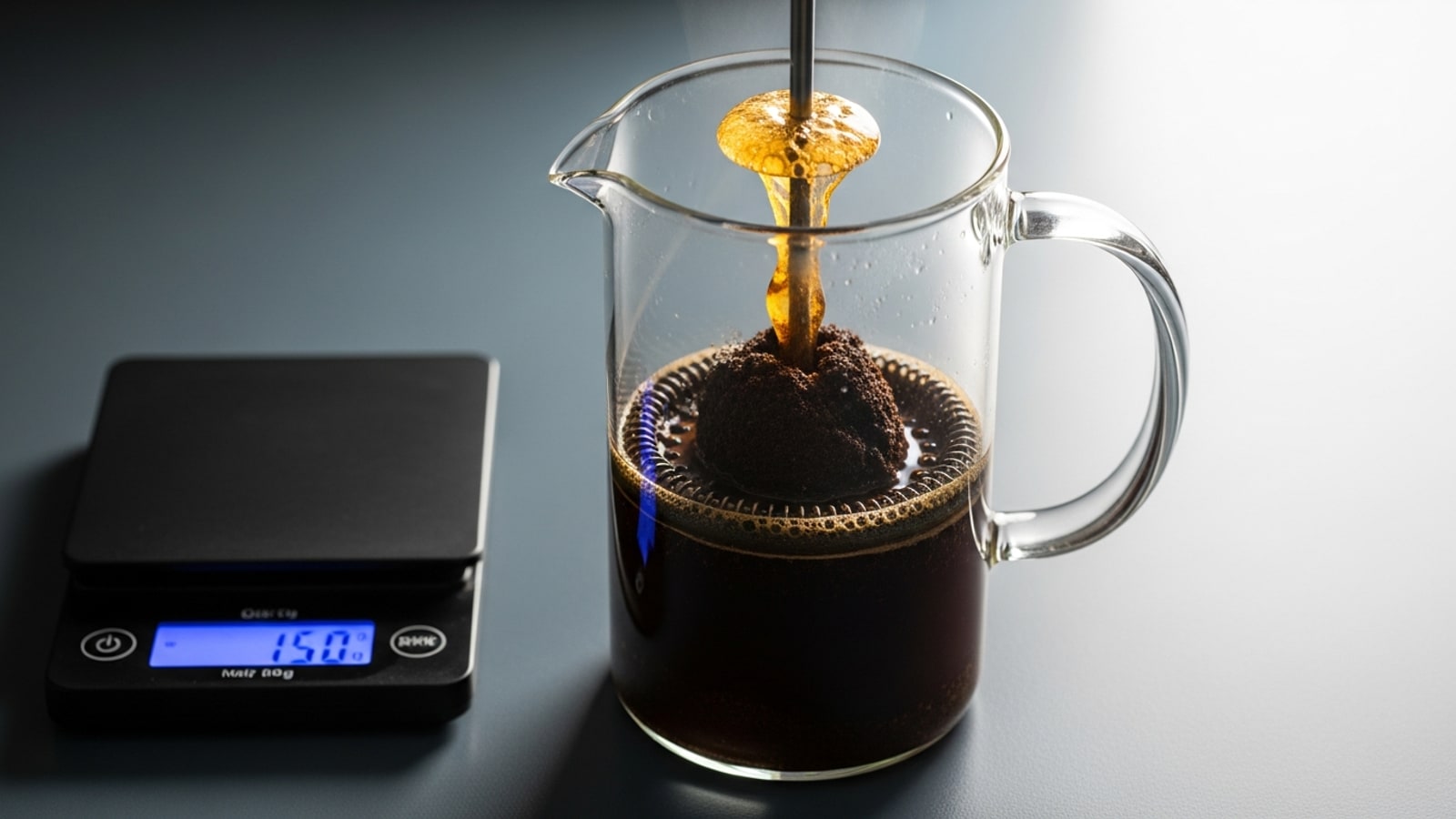
The most accurate way to brew French press is by weight. A $20 kitchen scale that reads to 0.1 g is the single most useful upgrade for home coffee. If you do not own one, the volume conversion is good enough.
The rough equivalents:
- 1 tablespoon of whole bean or coarse ground coffee weighs about 5 to 6 g
- 1 cup of water is 240 ml (US measuring cup)
- 1 fluid ounce of water is 30 ml
So for a 32 oz press, you want about 10 to 12 tablespoons of coffee to 4 cups (960 ml) of water. For a 12 oz press, about 4 tablespoons of coffee to 1.5 cups (360 ml) of water.
Volume is less accurate because ground coffee varies in density with roast, origin, and grind size. A light roast weighs more per tablespoon than a dark roast. A coarser grind packs less tightly than a finer one. The differences add up. For water, a glass measuring cup is fine since 100 ml of water weighs 100 g.
Grind size for French press
French press uses a coarse grind. Coarse looks like sea salt. Big, chunky particles you can clearly see, with visible space between them. If your grind looks like sand or table salt, it is too fine. If it looks like cracked black pepper, it is in the right zone.
The reason for coarse is the metal mesh filter. Openings are around 200 microns wide. Particles smaller than that pass through and end up in your cup. Fine grinds produce dust and small fragments, which is why a French press brewed with espresso grind tastes muddy. Coarse grinds stay above the mesh threshold and pour clean.
There is a chemistry reason too. Coarse particles extract slower than fine particles because the surface area to volume ratio is lower. Over a 4 minute steep, coarse particles give up the right amount of flavor. Finer particles would over-extract. The whole 4 minute brew time assumption is built on coarse grind. Change the grind and you change the time.
Use a burr grinder on its coarsest setting or one click below. Blade grinders produce an uneven mix of coarse and fine, which is why blade-ground French press often tastes both under-extracted and bitter at the same time. A $40 burr grinder is the biggest upgrade you can make after the scale.
If you buy preground, ask the shop for a French press grind specifically. Most shops calibrate their burr grinder to a known coarse setting on request. The same approach works for cold brew at home, which uses the same coarse grind.
Brew time and the 4 minute default
The classic French press brew time is 4 minutes. Set a timer when you add the water. Press at 4:00. Decant.
Why 4 minutes. With a coarse grind and water at 200 F, a 4 minute steep extracts roughly 19 to 22 percent of the soluble material from the grounds. That window is the sweet spot for hot brewed coffee. Below 18 percent the cup is sour. Above 22 percent it turns bitter and astringent. 4 minutes lands you in the middle most of the time.
You will sometimes see recipes that call for 8 minutes. The idea is that after the initial extraction, the crust of grounds at the top settles and the steep slows down. By minute 6 to 8 you are getting marginal additional extraction at a much slower rate. The cup ends up slightly stronger but not over-extracted. Some baristas swear by it for darker roasts.
The 8 minute method only works with coarse grind and a careful crust break. If you stir the crust at 4 minutes, you accelerate extraction and 8 minutes turns bitter. If you skim the crust and leave the steep undisturbed, you can go longer. For your first hundred presses, stick with 4 minutes.
The water temperature dial
Target water temperature for French press is around 200 F (93 C). That is a touch below boiling. Pure boiling water (212 F) is too hot. It scalds the grounds and pulls bitter compounds out of the bean before the good flavors have time to extract. Most home electric kettles with temperature control let you dial 200 F directly.
If you do not own a temperature controlled kettle, the practical approach is to bring water to a boil and then wait about 30 seconds before pouring. By 30 seconds off the boil at sea level, the water has dropped to around 200 F. At higher elevation, water boils cooler, so the wait is shorter or zero.
The temperature window is wider than people think. Anywhere from 195 F to 205 F produces a fine cup. The reason temperature matters is the speed of extraction. Hotter water extracts faster. At 200 F, the speed lines up with the 4 minute brew time. Brew at 185 F and extend the time to 5 or 6 minutes. Brew with full boil water and cut the time to 3 minutes.
The same temperature target works for pour over coffee, which is also a 200 F brew. The moka pot runs a different temperature curve and does not need the off boil step.
Bloom or no bloom
The bloom is a 30 to 45 second pre-wet that wakes the grounds before the main pour. You pour just enough water to saturate the bed (about twice the weight of the coffee, so 60 g coffee gets a 120 ml bloom). You wait. You watch the grounds bubble and rise as the trapped carbon dioxide escapes. Then you add the rest of the water and start the brew timer.
The bloom is essential in pour over. It is optional in French press. The reason is that pour over relies on even saturation, and a dry pocket in the bed channels water around the grounds without extracting them. Full immersion brewing fixes that automatically because the grounds are submerged the entire time. Bloom or no bloom, every particle gets wet.
That said, blooming a French press for 30 seconds does produce a slightly better cup with fresh beans. Fresh coffee contains a lot of CO2. If you pour without a bloom, the gas releases all at once and pushes some water back up out of the bed, creating uneven saturation. A short bloom lets the CO2 escape first. If your beans are more than three weeks old, skip the bloom. The CO2 is gone and there is nothing to release.
The press technique
The plunger is the part most people get wrong, and it is the easiest fix.
At 4 minutes, press down slowly. The whole press should take 15 to 20 seconds, not 2. A slow press pushes the grounds gently to the bottom and lets the mesh do its job. A fast press creates pressure that forces fines through the filter and shoots oily compounds into the upper liquid. The cup tastes muddier and the press is harder to clean.
If the plunger meets significant resistance halfway down, do not force it. The grind is usually too fine and the grounds are jamming the mesh. Lift the plunger an inch, swirl gently to redistribute the grounds, and try again. Forcing a stuck plunger can crack the glass.
The other critical step is decanting. Pour the coffee out into a server, a thermos, or directly into cups as soon as you finish pressing. Even with the plunger down, the coffee keeps steeping. Five minutes after you press, the cup is noticeably more bitter. If you are not drinking it all immediately, decant into a thermal carafe.
Troubleshooting bitter, weak, muddy
Bitter cup. Bitterness in French press almost always means over-extraction. The fixes, in order of likelihood: shorten the brew time to 3:30, coarsen the grind one click, lower the water temperature to 195 F, or skip the crust break stir. Letting the coffee sit in the press after the plunge is also a common cause. Decant immediately.
Weak or watery cup. Under-extraction is the opposite problem. Lengthen the brew time to 4:30, finer up the grind one click (but stay in the coarse range), raise the water temperature to 205 F, or add more coffee. Often the simplest fix is the ratio. Try 1:14 instead of 1:15 and see if the body comes up.
Muddy or gritty cup. Sediment in the cup is a grind problem 90 percent of the time. The grind is too fine and small particles are passing through the mesh. Coarsen the grind. If your grinder is a blade rather than a burr, you are fighting an uphill battle and a burr grinder is the upgrade that will fix the most cups.
Sour cup. Sourness is a sign of severe under-extraction. The water was too cold, the brew was too short, the grind was too coarse, or the beans were too light a roast for the technique. Pull two levers at once: longer brew time and hotter water.
Astringent or drying cup. Astringency comes from over-extraction, but specifically from the tannins that release in the last minute of a long brew. The fix is to press at 3:30 instead of 4:00 and see if the dry finish goes away.
Inconsistent batch to batch. If the same recipe produces different cups on different days, the variable is usually grind. A blade grinder produces a different particle distribution every time you use it. A burr grinder produces the same one every time. The other suspect is water temperature, which varies if you pour straight from a stove kettle without a thermometer.
The same troubleshooting logic applies to iced coffee at home and even latte building, since both rely on a properly extracted base shot or brew.
Frequently asked questions
What is the best ratio for French press coffee? 1 gram of coffee to 15 grams of water. For a 32 oz press, that is about 60 g coffee to 900 ml water.
How much coffee for a 32 oz French press? About 60 g of coarse ground coffee, or roughly 10 to 12 tablespoons.
How long should French press brew? Four minutes from the moment you add the water. Some recipes go longer with darker roasts, but 4 minutes is the right starting point.
What grind size for French press? Coarse, like sea salt. The same grind that works for cold brew.
What water temperature? Around 200 F. Just off boiling. Wait 30 seconds after the kettle comes to a boil.
Why is my coffee bitter? Over-extraction. Shorten the brew, coarsen the grind, cool the water, or decant immediately after pressing.
Why is my coffee muddy? The grind is too fine. Particles are slipping through the mesh. Coarsen up.
Should I stir during the brew? No. A gentle crust break at 4 minutes is enough.
Can I leave coffee in the press? No. Decant immediately.
Is French press stronger than drip? Heavier in body and mouthfeel because the metal mesh lets oils through. Caffeine is similar at the same ratio.
The point of getting the ratio right
A French press is the most forgiving brew method in the kitchen. The recipe is short. The equipment is cheap. The room for error is wide. And once you have the ratio dialed, the cup is repeatable every morning for the cost of a small kitchen scale and a bag of fresh beans.
The press also outperforms a lot of fancier methods on the things that actually matter. Body. Mouthfeel. The chocolate and nut notes that paper filters strip out. If you are coming from drip and the cup has always tasted thin to you, the press is the upgrade that fixes the problem in one move. For a longer comparison of methods, the pour over vs espresso vs cold brew breakdown covers the tradeoffs in detail, and what is third wave coffee explains why home brewers care about these variables in the first place. Keeping the press clean matters too, and the same approach in how to clean a coffee maker applies to French press maintenance.
If you also love coffee shops, Pulled pays you real cash for checking in at any cafe. Drink the press at home Monday through Friday, drink the shop version on Saturday, and the app counts both. The best coffee apps in 2026 roundup covers the full list.
Get Pulled.
Earn up to $10,000 exploring coffee shops. Real cash. Real shops. Real rewards.
Download PulledRelated reading: how to make pour over coffee, how to froth milk at home, how to use a moka pot, how to earn money drinking coffee in 2026, and the Pulled card.
Our Picks
What we'd buy on Amazon for this
Bodum · Chambord French Press (34oz)
Bodum has been making the Chambord since 1974 and the design has not been updated meaningfully since.
$39.99
View on Amazon →Timemore · Chestnut C2 Manual Hand Grinder
Steel burrs at the price of ceramic competitors. Pour over and french press champion.


Pulled may earn a commission on purchases. Cookie applies to all Amazon items in your next 24 hours, not just this product.
See all Pulled Picks →Keep going with Pulled