May 10, 2026
How to Make Vietnamese Coffee: The Complete Guide to Ca Phe and Ca Phe Sua Da
Vietnamese coffee is one of the great coffee traditions of the world. A small metal filter, dark roasted beans, sweetened condensed milk, and time. The setup looks simple. The result is rich, sweet, intense, and unlike anything that comes out of a drip machine or an espresso lever.
The drink most people know is ca phe sua da. Iced milk coffee. A layer of sweetened condensed milk in the bottom of a glass, dark coffee dripping over it from a phin filter, then a stir and a pour over a stack of ice. It is on the menu of every Vietnamese cafe and increasingly every third wave shop in America. It is also one of the easiest cafe drinks to make at home.
What is Vietnamese coffee
Vietnamese coffee is the brewing style that developed after coffee was introduced to Vietnam by the French in the mid 1800s. The French brought drip culture and a love of strong dark coffee. Vietnam adapted both to local conditions. Fresh milk did not keep well in the tropical heat before refrigeration, so sweetened condensed milk became the standard companion. Robusta grew well in the Central Highlands, so it became the dominant bean. The small metal drip filter that sits on top of the cup, the phin, became the standard tool.
The result is recognizably Vietnamese rather than French. Stronger and more concentrated than European drip, sweeter and creamier than American black coffee. Vietnam is now the second largest coffee exporter in the world after Brazil.
The defining drinks are ca phe (hot black), ca phe sua (hot with sweetened condensed milk), ca phe da (iced black), and ca phe sua da (iced with sweetened condensed milk). Each is the same brewing method with a different finish.
The phin filter and how it works
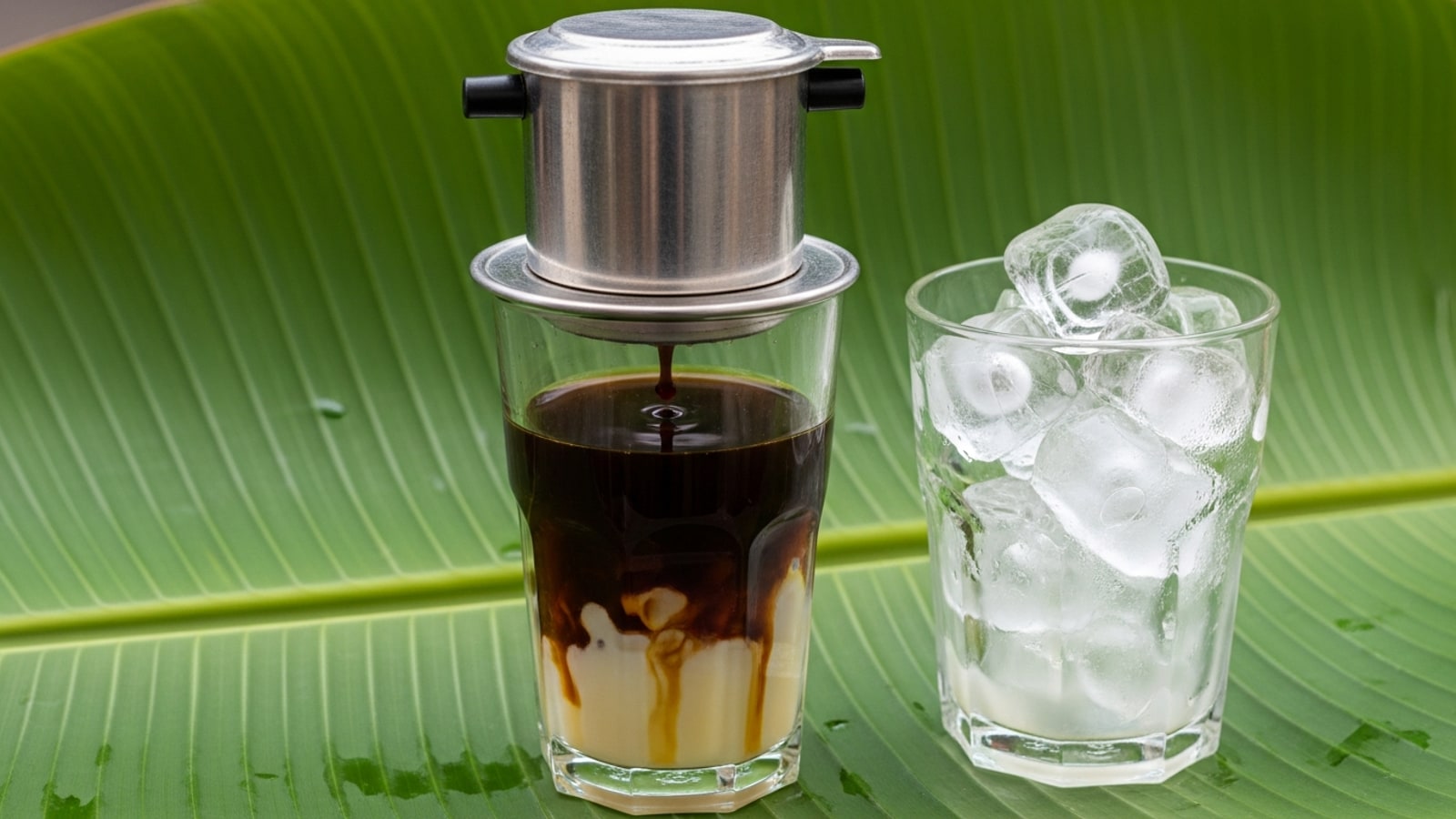
The phin is the small metal filter that sits on top of the cup. It is the most important piece of equipment in Vietnamese coffee, and it costs about five dollars at any Vietnamese grocery or online. There is no good substitute. A pour over dripper makes a different drink. An espresso machine makes a different drink.
The phin has four parts: a bottom plate with small holes that sits on the rim of the cup, a chamber that holds the grounds, a perforated metal disc (the press) that rests on top of the grounds, and a lid that traps the heat during the brew.
The method is straightforward. Add a few tablespoons of coarsely ground coffee to the chamber. Place the press on top gently. Pour hot water over the press. The water saturates the grounds and slowly drips through the bottom plate into the cup below. A good brew takes four to six minutes.
A small phin makes three to four ounces, the standard single serving. A large phin makes six to eight ounces. Start small. Cleaning is easy: rinse with hot water after use, dry, put away. A simple coffee maker cleaning routine applies to the phin too.
The beans: dark roast robusta blend
This is the part that throws off most American coffee drinkers. Vietnamese coffee is traditionally made with robusta beans, often blended with a small amount of arabica, and roasted dark. None of that is what specialty coffee in the United States looks like, where light roasted single origin arabica is the standard.
Robusta has more caffeine than arabica, more body, less acidity, and a stronger flavor. It is the bean that builds the heavy mouthfeel Vietnamese coffee is known for. A 100 percent arabica brew in a phin will produce something acceptable but thin. It will not taste like ca phe sua da from a Vietnamese cafe.
The most famous Vietnamese brand is Trung Nguyen, sold in red and gold cans at most Vietnamese and Asian grocery stores. Other options include Cafe Du Monde (a New Orleans brand that includes chicory and is popular for the same hot climate reasons), Phuc Long, and Highlands Coffee. For grind, aim for coarse to medium coarse. Closer to French press than drip. Fine espresso grind will clog the phin. If you want to use American specialty beans, a dark roast Sumatra or French roast blend works.
The role of sweetened condensed milk
Sweetened condensed milk is not a substitute for fresh milk or sugar. It is its own ingredient and it is essential to the drink. The combination of sugar and concentrated milk solids gives ca phe sua and ca phe sua da their creamy sweetness that no other ingredient replicates.
The standard brand in Vietnam is Longevity. Eagle Brand is widely available in the United States and produces a very similar result. Any sweetened condensed milk works.
Important note. Sweetened condensed milk is not evaporated milk. Evaporated milk is unsweetened. Sweetened condensed milk has sugar added during concentration, which is why it is thick, sticky, and noticeably sweet straight from the can. Read the label.
The standard ratio is two tablespoons of sweetened condensed milk (30 g) per small phin of coffee. Enough to balance a strong dark brew without burying the coffee. Adjust to taste.
How to make hot Vietnamese coffee (ca phe sua)
This is the foundation drink. Once you can make ca phe sua, you can make ca phe sua da by adding ice, ca phe by skipping the milk, and ca phe trung with whipped egg yolk.
Step 1. Spoon two tablespoons of sweetened condensed milk (30 g) into the bottom of a heavy heatproof glass or cup.
Step 2. Place the phin on top of the glass. Add two tablespoons of coarsely ground coffee (15 g) and shake gently to level. Place the press on top. Do not push down. The press should rest under its own weight.
Step 3. Heat water to just off the boil, around 200 F (93 C). Pour about one tablespoon (15 ml) over the press first. Wait 30 seconds for the bloom.
Step 4. Pour the remaining three ounces (90 ml) slowly over the press, filling the chamber. Place the lid on the phin.
Step 5. Wait. A good drip is one drop every one to two seconds. Total brew time is four to six minutes. If it finishes in under three minutes, the grind is too coarse. If it stops dripping, the grind is too fine or you tamped too hard.
Step 6. When the chamber empties, lift the phin off and set it on a saucer. Stir until uniform. Serve hot.
How to make iced Vietnamese coffee (ca phe sua da)
Ca phe sua da is iced milk coffee. The same brewing method, with ice added at the end. This is the version that crossed over to American cafe menus.
Step 1. Spoon two to three tablespoons of sweetened condensed milk (30 to 45 g) into a small heatproof glass. Use more for the iced version. The ice dilutes the drink, so you need a stronger sweet base.
Step 2. Place the phin on top. Add two tablespoons of coarsely ground coffee (15 g), shake to level, and place the press on top.
Step 3. Bloom with one tablespoon of hot water (15 ml). Wait 30 seconds. Pour the remaining three ounces (90 ml) and cap with the lid.
Step 4. Let the coffee drip for four to six minutes.
Step 5. Remove the phin and stir until uniform.
Step 6. Fill a tall serving glass with ice, about one full cup. Pour the hot coffee mixture over the ice. Stir briefly and serve immediately.
The reason ca phe sua da works is similar to a flash chilled iced coffee. Hot coffee hits cold ice and chills immediately, locking in aromatics that would otherwise dissipate. If you want the slow, never hot version with the same Vietnamese beans, our cold brew guide covers the method, and our iced coffee guide covers the standard American style.
How to make egg coffee (ca phe trung)
Ca phe trung is the Hanoi specialty. Egg yolk and sweetened condensed milk whipped together into a thick custard-like foam, then floated on top of hot Vietnamese coffee. The story commonly told is that it was invented in the 1940s as a wartime workaround during a milk shortage. The drink it produced is unlike anything else in the coffee world.
Step 1. Brew a strong phin of coffee directly into a small heatproof cup. Skip the sweetened condensed milk at the bottom this time. The egg foam provides the sweet milk component.
Step 2. While the coffee drips, separate one egg yolk into a small bowl. Add two tablespoons of sweetened condensed milk (30 g). Whip with a hand mixer for three to five minutes. The mixture turns thick, glossy, and pale yellow. The foam should hold soft peaks.
Step 3. Gently spoon the egg foam on top of the hot coffee. If it sinks, you did not whip it long enough.
Step 4. Serve immediately. Eat the foam with a spoon while sipping the coffee underneath. Tiramisu is the closest reference point in Western dessert. If raw egg is a concern, use pasteurized eggs.
Common mistakes
1. Wrong grind. Too fine chokes the phin. Too coarse runs through in two minutes. Aim for coarse, similar to a French press grind. The coarse grind French press uses is a useful reference.
2. Tamping too hard. The press should rest on the grounds under its own weight. If you compact the bed, water cannot pass.
3. Water too cool. The phin needs water just off the boil. Around 200 F (93 C). Lukewarm produces a thin, underdeveloped brew.
4. Skipping the bloom. Dry grounds need 30 seconds to absorb water and release CO2. The pre-pour is small but it matters.
5. Wrong beans. 100 percent light roast arabica is acceptable but not Vietnamese coffee. Use robusta or a robusta blend, dark roasted.
6. Evaporated milk by mistake. Evaporated milk has no sugar and is not the same product. Read the label.
7. Not stirring. The sweetened condensed milk sits in a thick layer at the bottom. The first sips are bitter and the last are pure sweet milk if you skip the stir.
8. Dirty phin. Coffee oils build up on metal over time and give a stale flavor. Rinse with hot water after every use.
Vietnamese coffee in the wider coffee world
Vietnamese coffee is a slow drip method, like pour over, but heavier and more concentrated. It is strong, like espresso, but gravity fed rather than pressure driven. The closest comparison is the moka pot, which also makes a small dark cup from a one piece stovetop tool. Our moka pot guide covers that.
It sits outside the usual specialty coffee conversation. Third wave shops emphasize light roasted single origin arabica brewed with precision pour over methods. Vietnamese coffee is the opposite: dark roast, robusta dominant, brewed with sweetened condensed milk. Our third wave coffee guide covers that framework. For a broader comparison see pour over vs espresso vs cold brew and how to make pour over coffee.
For milk drinks, ca phe sua is closest in spirit to a sweetened latte. Both are coffee plus sweetened milk. The Vietnamese version uses sweetened condensed milk and a phin drip. The Italian version uses steamed fresh milk and an espresso shot. The drinks taste nothing alike. If you want the espresso version, our home latte guide covers it and how to froth milk covers the texture.
Frequently asked questions
Do I have to use a phin? The phin produces the heavy concentrated brew the drink is built around. Other methods approximate it but the result is not the same. The phin is cheap and lasts forever.
Can I use regular American coffee? Yes, but it will not really taste like Vietnamese coffee. The robusta and dark roast are part of what makes the cup what it is.
Ca phe sua vs ca phe sua da? Sua means milk, da means ice. Ca phe sua is hot. Ca phe sua da is the iced version.
How much caffeine is in it? A small phin of ca phe sua da has a similar caffeine load to a strong drip coffee or a single espresso shot.
Without sweetened condensed milk? Black Vietnamese coffee is ca phe (hot) or ca phe da (iced). Both skip the milk entirely.
Is robusta lower quality? Robusta is a different bean with different uses. The reputation comes from cheap commodity robusta. Well grown robusta is a different product.
What size phin? A small phin (3 to 4 ounces) is the standard single serving size and the one to start with.
Can I batch the iced version? Brew the concentrate in advance and refrigerate for a day or two. The flavor softens but the drink is still good.
Why making it at home is worth it
Ca phe sua da at a cafe runs five to seven dollars. A phin costs five dollars one time. A can of Trung Nguyen runs eight to ten dollars and brews dozens of cups. The home version costs pocket change per cup, and you can tune the drink to your taste.
If you still want to support the Vietnamese cafes and the third wave shops in your city, Pulled Coffee pays you back real cash for every check-in at any coffee shop. See how the challenges work, read about how members are earning money drinking coffee in 2026, or check out the Pulled Card.
Get Pulled.
Earn up to $10,000 exploring coffee shops. Real cash. Real shops. Real rewards.
Download PulledRelated reading: how to make cold brew at home, how to make iced coffee at home, how to make a latte at home, how to make pour over coffee, how to use a moka pot, the best coffee apps in 2026.
Our Picks
What we'd buy on Amazon for this
Third Wave Water · Classic Light Roast Profile (12-pack)
Third Wave Water solves the brewing water problem with a pre-formulated mineral mix.
Bodum · Pavina Double-Wall Glasses (Set of 6, 12oz)
The cafe glass for serving iced lattes, iced Americanos, and cold brew at home.
$40.99
View on Amazon →Hario · Cupping Spoon (Kasuya Model)
The right shape matters.



Pulled may earn a commission on purchases. Cookie applies to all Amazon items in your next 24 hours, not just this product.
See all Pulled Picks →Keep going with Pulled