May 10, 2026
How to Make Turkish Coffee: The Complete Guide to Cezve, Grind, Foam, and the Tradition Behind It
Turkish coffee is the oldest brewing method still made the same way it has been made for five centuries. No filter, no plunger, no machine, no pressure. A small copper pot, water, a powder-fine grind, and a quiet flame. Simple technique. Unlike any other cup on the planet.
This guide covers the cezve, the grind, the ratio, the heat, the kopuk, the four sugar levels, the tradition of reading the grounds, and the mistakes that ruin a first attempt. Turkish coffee tradition was added to the UNESCO Representative List of the Intangible Cultural Heritage of Humanity in 2013, and it is worth treating that history with care.
What makes it Turkish coffee
The defining feature is that the grounds and the water are never separated until the coffee reaches your cup. No filtration. The grounds are ground to a near-powder, brewed directly in the pot, poured into a small cup, and allowed to settle. You drink from the top and leave a thick sludge of grounds at the bottom.
That single decision (no filter) drives every other detail. It is why the grind has to be powder, why the heat has to be low, why the brew is small, why the foam matters so much.
The method spread from the Ottoman Empire in the 16th century through the Balkans, the Middle East, and North Africa. It travels under different names (Greek coffee, Bosnian coffee, Armenian coffee, Arabic coffee), but the core technique is the same. Cup small. Pot small. Grind powder. Heat slow.
The cezve (ibrik) explained
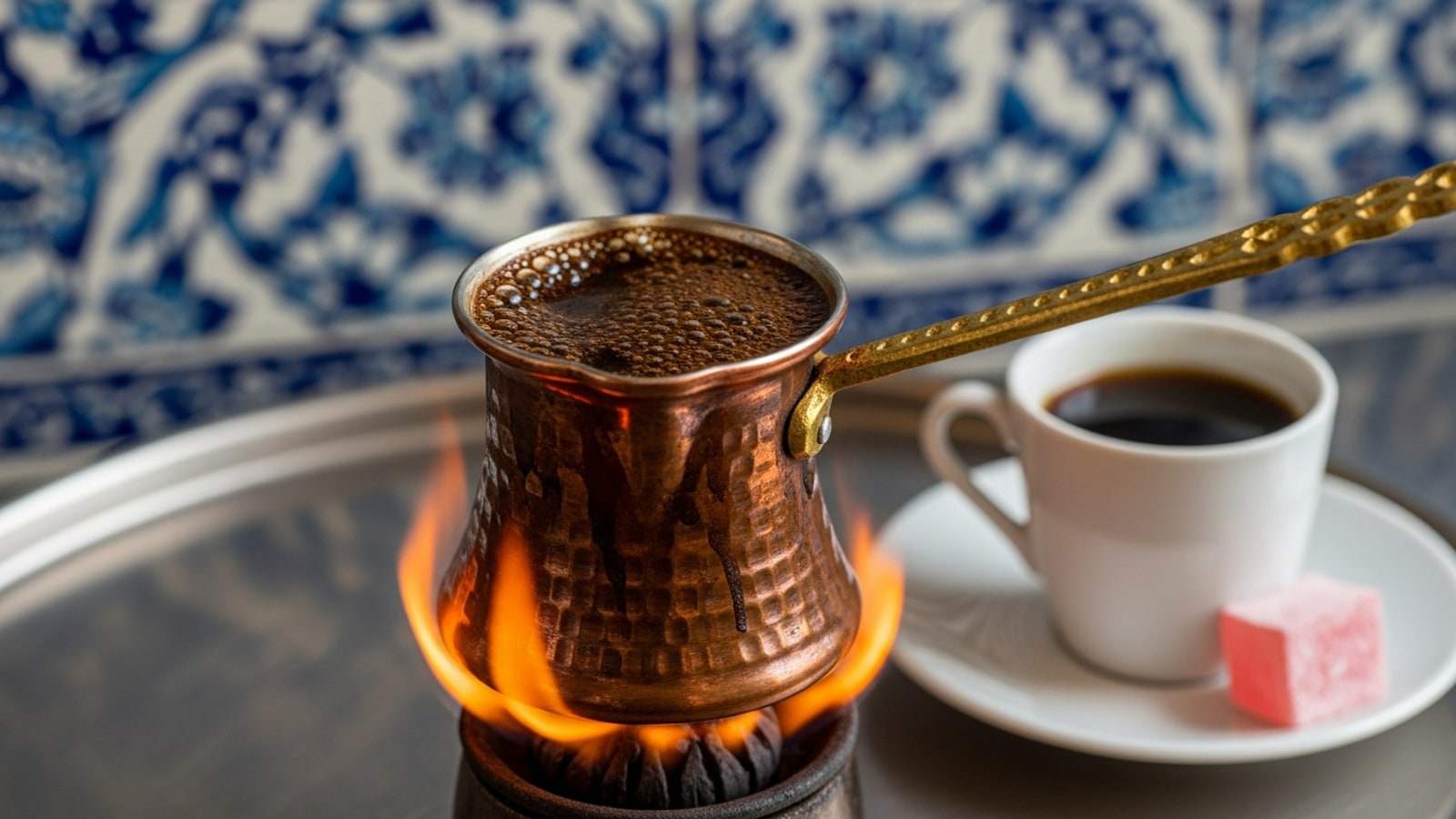
The brewing pot is called a cezve in Turkish (pronounced "jez-veh") or an ibrik in Arabic and English coffee circles. Both refer to the same tool: a small, long-handled pot, usually copper with a tin lining. The shape is specific: wide at the bottom, narrow at the top, with a pinched pour spout. The wide base heats water evenly. The narrow neck slows the rising foam so it builds into a thick layer before it boils over.
Sizes are measured by how many demitasse cups the pot brews. Two-cup and three-cup sizes are practical for home. A four-cup pot brewing one cup will not develop foam properly because the surface area is wrong. Copper with a tin lining is the traditional build: the copper conducts heat evenly, the tin protects against the acidity of coffee.
The grind: finer than espresso, like powdered sugar
Turkish coffee uses the finest grind of any brewing method. Finer than espresso. The texture should be closer to flour or powdered sugar than to sand. Rub a small amount between your fingers: it should feel smooth, with no detectable grit.
The reason is the no-filter design. Too coarse and the grounds sit at the bottom as gritty sediment and the coffee tastes thin. Powder fine and they extract fully during the short brew, with the suspended fines giving the drink its silky body.
Most home grinders cannot grind this fine. A standard burr grinder for espresso tops out one or two notches above true Turkish fine. A hand-cranked Turkish mill (the tall brass grinders you see in markets) is built for this. If your grinder cannot reach Turkish fine, buy preground from a Middle Eastern grocery or ask a specialty shop to grind for Turkish. Get the grind right and most other problems disappear.
Ratio: one heaping teaspoon per cup
One heaping teaspoon of coffee per demitasse cup of water is the standard ratio. A demitasse cup holds about 2 oz of water (60 ml). One heaping teaspoon of finely ground coffee is roughly 7 to 8 grams. That works out to roughly a 1:8 ratio by weight, close to espresso strength.
Pour the water into the cezve using the cup you are going to drink from. That guarantees the volume is right for both. If you want a stronger cup, do not add more coffee: Turkish is already intense at this ratio, and more grounds just make it bitter.
Some traditions add a pinch of ground cardamom (around 1/4 teaspoon for two cups) to the cezve with the coffee. Common in Arabic and Lebanese versions and in some Turkish ones. Optional and personal.
Heat technique: low and slow
Turkish coffee is not boiled. That is the most common mistake. The water heats slowly over a low flame, the foam builds gradually, and the coffee is removed before it ever reaches a boil. If it boils, the foam collapses and the cup tastes flat and burnt.
Set your stove to low. On gas, the flame should be visible but not aggressive. On electric or induction, around 3 or 4 out of 10. The whole brew, from cold water to finished pour, takes 3 to 4 minutes. Faster than 2 minutes and your heat is too high.
Some traditions brew in hot sand (a basin of fine sand over flame, with the cezve buried partway in). The sand transfers heat slowly and evenly. You see this at traditional cafes across the Levant. At home, a low flame is close enough.
The foam (kopuk)
The foam is called kopuk in Turkish. It is the single most important visual marker of a properly brewed cup. A Turkish coffee without kopuk is considered a failed brew.
The kopuk is not the same as the crema on espresso. It is denser, tan colored, and made of the natural oils and fines that rise during the slow heat. The texture is creamy without any dairy. A good kopuk holds for the first several sips.
Three rules for getting good kopuk. First, do not stir once the brew is underway. Stir once at the start to wet the grounds, then leave it alone. Second, keep the heat low. High heat boils the foam off before it builds. Third, remove from heat before the rim. Pull the cezve at the moment the foam is about to climb past the spout.
If your first attempt has no foam, the cause is one of three things: grind too coarse, heat too high, or you stirred during the brew. Adjust one variable at a time.
Sugar levels: sade, az sekerli, orta, sekerli
Sugar is added to the cezve at the start, with the coffee and the water. Not at the cup. You cannot stir Turkish coffee in the cup without disturbing the grounds, so the sugar has to dissolve into the brew during cooking. You choose your level before you brew. The four standard levels are part of the tradition.
Sade means plain, no sugar. The choice for tasting the coffee at full intensity.
Az sekerli means lightly sweet. About 1/2 teaspoon per cup, just enough to soften the edge.
Orta means medium. One teaspoon per cup. The most common choice and the cafe default if you do not specify.
Sekerli means sweet. About 1.5 to 2 teaspoons per cup. Properly sweet without being syrupy.
If you are serving guests, ask each person which level they want and brew separate cups if preferences differ. Mixing levels in one pot is not possible.
The procedure step by step
Step 1. Measure water by pouring from the demitasse cup directly into the cezve. Two ounces (60 ml) per cup.
Step 2. Add coffee. One heaping teaspoon per cup of water. Do not pack the spoon.
Step 3. Add sugar to taste. Sade (none), az sekerli (1/2 teaspoon per cup), orta (1 teaspoon), sekerli (1.5 to 2 teaspoons). If using cardamom, add 1/4 teaspoon now.
Step 4. Stir gently once to wet the grounds and start dissolving the sugar. Place the cezve over a low flame.
Step 5. Do not stir again. Over 2 to 3 minutes the surface goes from flat to a thick tan layer of kopuk.
Step 6. Just before the foam reaches the rim, remove from the heat. Spoon a small amount of foam into each demitasse cup.
Step 7. Return the cezve to the low flame for 10 to 15 more seconds, then remove again.
Step 8. Pour the rest of the coffee slowly into each cup. The remaining foam sits on top.
Step 9. Rest the cup for one minute so the grounds settle.
Step 10. Drink slowly from the top. Stop when you taste grit. The bottom centimeter is sediment.
Reading the grounds: tasseography
When you finish drinking, the cup is still half-useful. The pattern of grounds at the bottom is read for fortune telling in a tradition called tasseography (kahve fali in Turkish). The drinker swirls the leftover grounds, inverts the cup onto the saucer, lets it cool, then a reader interprets the shapes that form along the inside.
The tradition is practiced socially across Turkey, the Balkans, and the Middle East. The reader looks for animals, letters, paths, and symbols in the patterns. A road might mean a journey. A bird might mean news. The interpretation is personal.
Whether you take it seriously or not, the tradition is part of the social ritual. People sit, drink, talk, and read each other's cups afterward. The coffee is the start of a conversation, not the end.
Mistakes that ruin Turkish coffee
1. Wrong grind. Espresso-fine is not fine enough. Powder is the target.
2. Heat too high. Medium or high flame burns the foam off before it forms.
3. Boiling the coffee. Once it boils, the kopuk collapses. Pull the cezve before the foam reaches the rim.
4. Stirring during the brew. Stir once at the start, then do not touch the spoon.
5. Adding sugar after pouring. Sugar goes in the cezve, not the cup.
6. Wrong-size pot. A four-cup cezve brewing one cup will not develop foam.
7. Drinking to the bottom. The last centimeter is grounds. Stop when you taste sediment.
8. Using stale beans. Turkish coffee will not hide stale flavors. Use beans roasted within the past month.
9. Skipping the rest before drinking. Set the cup down for a full minute. If you drink immediately, the grounds are still suspended and the cup is gritty.
10. Using a warm pot. Start cold. The slow heating is part of the brewing chemistry.
How Turkish coffee compares to other methods
Most coffee methods separate the grounds from the liquid before serving. Turkish does not. That difference puts it in its own family alongside the few other unfiltered methods.
Compared to a moka pot, Turkish is unfiltered, smaller, and slower. The moka pot uses steam pressure through a metal filter. Compared to a French press, Turkish is finer ground and far stronger per ounce. Compared to pour over, it is the opposite drink: pour over is bright and filtered, Turkish is dense and unfiltered.
Compared to Vietnamese coffee, Turkish is unsweetened by default (or sweetened in the brew). Vietnamese is traditionally sweetened with condensed milk and uses a phin filter.
Compared to pour over, espresso, or cold brew, Turkish is closest to espresso in intensity per ounce, but the textures are different. Espresso has crema. Turkish has kopuk. Compared to cold brew or iced coffee, Turkish is the opposite end of the temperature spectrum. You do not usually make a Turkish-style latte or any milk-based drink from this base.
Frequently asked questions
Cezve or ibrik? Same pot. Cezve is Turkish, ibrik is Arabic. Both describe the small copper brewing pot with a long handle.
How fine should the grind be? Powder fine. Finer than espresso, closer to flour than sand. Most home grinders cannot reach this fine, so preground Turkish from a Middle Eastern grocery is usually easiest.
Can I brew without a cezve? You can brew in any small pot, but the foam will not form properly because the cezve shape is what produces the kopuk.
Why does my coffee have no foam? Grind too coarse, heat too high, or you stirred during the brew. Fix one variable at a time.
Do I drink the grounds? No. Rest the cup a minute, drink from the top, stop when you taste sediment.
How much caffeine? Roughly 50 to 65 mg per 2 oz cup, similar to a single espresso.
Is Turkish coffee the same as Greek or Arabic coffee? The brewing method is the same. Regional differences appear in spices, sugar conventions, and serving rituals.
Should I add cardamom? Optional. A pinch in the cezve at the start. Try one batch with and one without.
Keeping the tradition
Turkish coffee is the only popular brewing method whose entire technique is built around hospitality. The cup is small because you are meant to sit and finish it slowly. The grounds are read because someone is meant to read them. The sugar level is asked because someone is meant to brew exactly to your preference. The whole ritual exists to slow you down.
There are faster ways to brew coffee. There are not really better ones for the moments when you actually have time. If you are cleaning out an old drip machine and looking for a slower option, a cezve costs less than a good electric kettle and lasts decades. The third wave movement has revived interest in traditional unfiltered methods, and Turkish coffee is having a quiet renaissance.
For finding shops that brew Turkish and other traditional methods near you, Pulled Coffee tracks specialty cafes and pays cash for every check-in. The earnings page explains the challenges, this 2026 guide walks through how members are turning cafe visits into rent money, and the Pulled Card adds another lane of rewards for people who travel for coffee.
Get Pulled.
Earn up to $10,000 exploring coffee shops. Real cash. Real shops. Real rewards.
Download PulledRelated reading: how to make pour over coffee, how to use a moka pot, the French press coffee ratio, how to make Vietnamese coffee, pour over vs espresso vs cold brew, the best coffee apps in 2026.
Our Picks
What we'd buy on Amazon for this
Third Wave Water · Classic Light Roast Profile (12-pack)
Third Wave Water solves the brewing water problem with a pre-formulated mineral mix.
Bodum · Pavina Double-Wall Glasses (Set of 6, 12oz)
The cafe glass for serving iced lattes, iced Americanos, and cold brew at home.
$40.99
View on Amazon →Hario · Cupping Spoon (Kasuya Model)
The right shape matters.



Pulled may earn a commission on purchases. Cookie applies to all Amazon items in your next 24 hours, not just this product.
See all Pulled Picks →Keep going with Pulled